

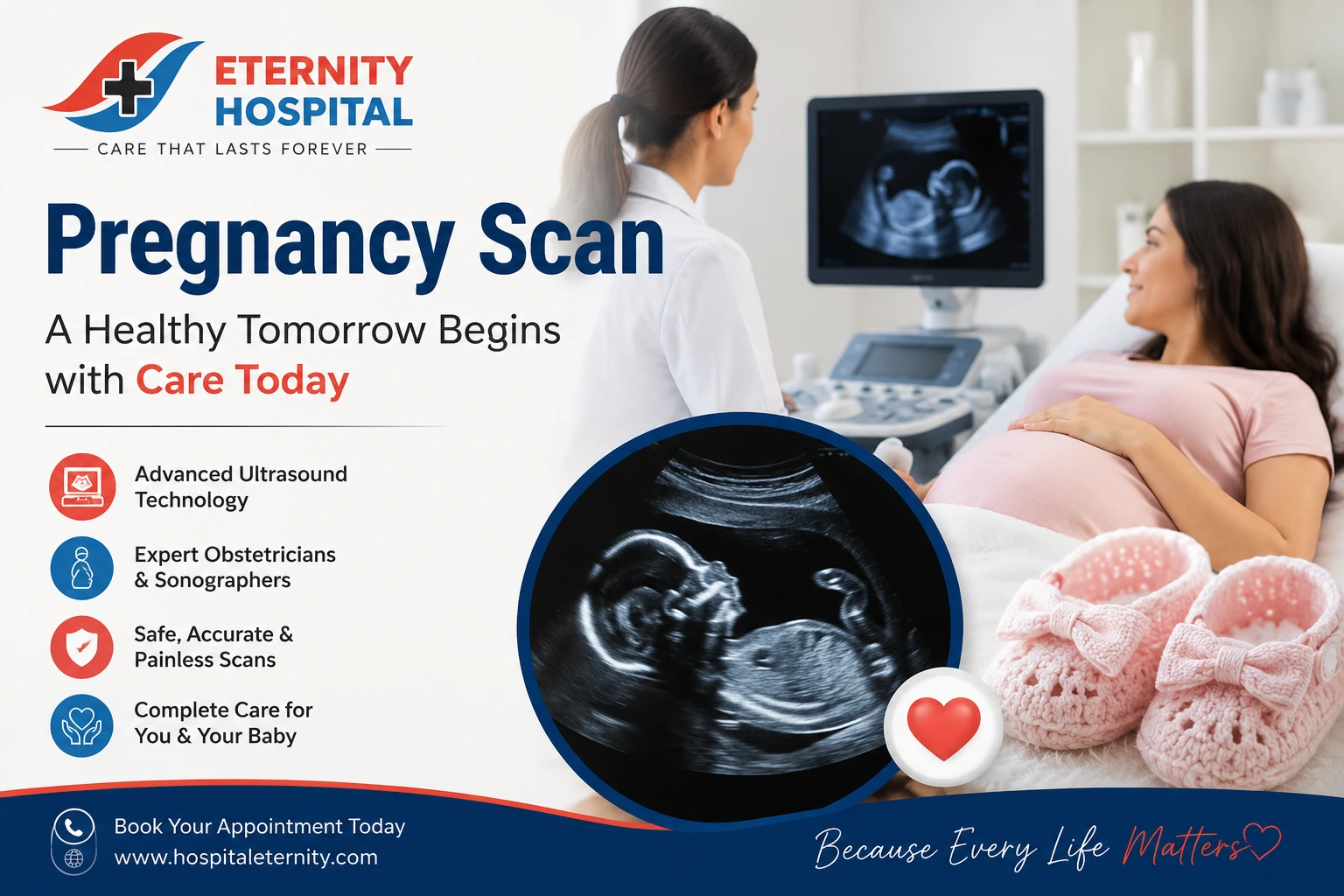
Pregnancy is an exciting journey, and regular pregnancy scans play a vital role in ensuring the health and well-being of both the mother and the developing baby. Ultrasound scans help doctors monitor fetal growth, detect any abnormalities, determine the baby’s position, and estimate the due date. These scans are safe, painless, and an essential part of routine prenatal care.
If you’re looking for expert pregnancy care and advanced diagnostic services, consider Eternity Hospital. The hospital offers comprehensive maternity care under the guidance of experienced gynecologists, helping expectant mothers enjoy a healthy and stress-free pregnancy.
What Is a Pregnancy Scan?
A pregnancy scan, also known as an obstetric ultrasound, uses high-frequency sound waves to create images of the baby inside the womb. Unlike X-rays, ultrasound does not use radiation, making it a safe imaging method during pregnancy.
Doctors recommend multiple scans throughout pregnancy to monitor fetal development, confirm the baby’s heartbeat, assess the placenta, and identify any complications early.
Why Are Pregnancy Scans Important?
Pregnancy scans provide valuable information about both the mother and baby. They help:
- Confirm pregnancy.
- Estimate the due date.
- Check the baby’s heartbeat.
- Monitor fetal growth and development.
- Detect congenital abnormalities.
- Assess the placenta and amniotic fluid.
- Identify multiple pregnancies (twins or triplets).
- Monitor the baby’s position before delivery.
- Guide treatment if complications arise.
Regular scans give parents peace of mind while allowing doctors to provide timely medical care if needed.
Types of Pregnancy Scans
1. Early Pregnancy Scan (6–10 Weeks)
This scan confirms pregnancy and checks whether the pregnancy is developing normally.
It helps determine:
- Baby’s heartbeat
- Gestational age
- Estimated due date
- Number of babies
- Location of pregnancy
2. Dating Scan (8–14 Weeks)
The dating scan accurately estimates the baby’s age and expected delivery date. It is especially useful if the mother’s menstrual cycle is irregular.
3. NT Scan (11–14 Weeks)
The Nuchal Translucency (NT) scan measures fluid behind the baby’s neck. Combined with blood tests, it helps assess the risk of chromosomal conditions such as Down syndrome.
4. Anomaly Scan (18–22 Weeks)
This is one of the most detailed pregnancy scans.
The doctor carefully examines:
- Brain
- Heart
- Spine
- Kidneys
- Face
- Limbs
- Abdomen
It helps detect structural abnormalities and confirms normal fetal development.
5. Growth Scan (28–36 Weeks)
A growth scan monitors:
- Baby’s weight
- Growth rate
- Placental function
- Amniotic fluid level
- Baby’s position
This scan is particularly important for high-risk pregnancies.
6. Doppler Scan
A Doppler ultrasound evaluates blood flow between the placenta, umbilical cord, and baby. It is recommended if the doctor suspects restricted fetal growth or pregnancy complications.
7. 3D and 4D Pregnancy Scan
These advanced scans produce detailed images of the baby’s face and body.
Benefits include:
- Better visualization of fetal structures
- Detection of facial abnormalities
- Enhanced bonding experience for parents
Are Pregnancy Scans Safe?
Yes.
Ultrasound scans have been used worldwide for decades and are considered safe when performed by trained healthcare professionals. They do not expose the mother or baby to harmful radiation.
Doctors recommend scans only when medically necessary as part of routine prenatal care.
How Should You Prepare for a Pregnancy Scan?
Preparation depends on the type of scan.
You may be advised to:
- Drink water before the scan for a full bladder during early pregnancy.
- Wear comfortable clothing.
- Bring previous medical reports.
- Follow your doctor’s instructions regarding eating or drinking.
Most scans take between 15 and 45 minutes.
What Can Pregnancy Scans Detect?
Pregnancy scans help detect:
- Ectopic pregnancy
- Miscarriage risk
- Multiple pregnancies
- Birth defects
- Placenta previa
- Low amniotic fluid
- Excess amniotic fluid
- Growth restriction
- Breech presentation
- Umbilical cord abnormalities
Early diagnosis allows doctors to plan appropriate treatment and improve pregnancy outcomes.
How Many Pregnancy Scans Are Needed?
The number of scans depends on the mother’s health and pregnancy risk.
For a normal pregnancy, doctors generally recommend:
- Early pregnancy scan
- NT scan
- Anomaly scan
- Growth scan
High-risk pregnancies may require additional ultrasounds for closer monitoring.
Benefits of Regular Pregnancy Scans
Routine pregnancy scans offer several advantages:
- Monitor healthy fetal development.
- Detect complications early
- Reduce pregnancy-related risks
- Improve delivery planning
- Monitor placental health
- Assess fetal movement and growth.
- Reassure expecting parents
Regular prenatal imaging is one of the most effective ways to ensure a healthy pregnancy.
Pregnancy Care at Eternity Hospital
At Eternity Hospital, expectant mothers receive comprehensive maternity services, including prenatal consultations, pregnancy scans, fetal monitoring, high-risk pregnancy management, and delivery care. Led by experienced gynecology specialists, the hospital focuses on personalized care, advanced diagnostic technology, and the safety of both mother and baby throughout every stage of pregnancy.
When Should You Contact Your Doctor Immediately?
Seek medical attention if you experience:
- Heavy vaginal bleeding
- Severe abdominal pain
- Persistent headache
- Reduced fetal movements
- Leakage of fluid
- High fever
- Sudden swelling of the face or hands
Prompt evaluation can help prevent serious complications.
What Is a Pregnancy Scan? (Add After Existing Content)
Pregnancy scans have become one of the most valuable diagnostic tools in modern obstetrics. They allow healthcare providers to closely monitor the baby’s growth and development throughout pregnancy while also evaluating the mother’s reproductive organs. Ultrasound imaging provides real-time pictures of the fetus, placenta, uterus, and amniotic fluid, enabling doctors to identify potential concerns before they become serious. This early detection plays a significant role in ensuring a safer pregnancy and healthier delivery.
The technology used in pregnancy scans is completely non-invasive and painless. A trained sonographer or radiologist performs the scan by applying a special gel to the abdomen and moving a handheld device called a transducer across the skin. In early pregnancy, a transvaginal ultrasound may be recommended for clearer images. The procedure usually takes between 15 and 30 minutes, depending on the purpose of the examination. Expectant parents also get the opportunity to see their baby moving, stretching, or even yawning, making the experience emotionally memorable while providing essential medical information.
Why Are Pregnancy Scans Important? (Add More Content)
Beyond confirming the pregnancy and estimating the due date, pregnancy scans provide continuous monitoring that helps healthcare professionals evaluate whether the baby is growing according to expected developmental milestones. Every trimester brings different changes, and ultrasound examinations help ensure these changes occur normally. If any growth delays or abnormalities are detected, doctors can recommend further investigations or specialized treatment plans.
Pregnancy scans are equally important for monitoring maternal health. They help identify conditions such as placenta previa, low-lying placenta, cervical shortening, or abnormal amniotic fluid levels, all of which may require closer observation. For women with high-risk pregnancies due to diabetes, hypertension, thyroid disorders, or previous pregnancy complications, regular ultrasound examinations become even more essential. Early diagnosis allows timely medical intervention, reducing the chances of complications during pregnancy and childbirth.
Early Pregnancy Scan (6–10 Weeks) (Add More Content)
The first pregnancy scan is often an emotional milestone for expecting parents because it provides the first visual confirmation of the baby. During this stage, doctors confirm whether the pregnancy is located inside the uterus and determine if it is progressing normally. They can also detect multiple pregnancies and assess whether the baby’s heartbeat is present, which is one of the earliest indicators of fetal viability.
This scan also helps identify conditions such as ectopic pregnancy, where the embryo develops outside the uterus. Since ectopic pregnancies can become life-threatening if left untreated, early diagnosis is extremely important. In addition, doctors assess the gestational sac, yolk sac, and embryo size to estimate the baby’s gestational age accurately, ensuring better planning for future prenatal care.
Dating Scan (Add More Content)
A dating scan provides one of the most accurate methods for calculating the expected delivery date, especially when performed during the first trimester. Accurate pregnancy dating is essential because it helps doctors schedule important prenatal tests, monitor fetal growth appropriately, and determine whether labor occurs prematurely or post-term.
Women who have irregular menstrual cycles often benefit significantly from a dating scan because calculating pregnancy based solely on the last menstrual period may be inaccurate. The scan measures the baby’s crown-rump length (CRL), which is considered the gold standard for estimating gestational age during early pregnancy.
NT Scan (11–14 Weeks) (Add More Content)
The Nuchal Translucency scan forms an important part of first-trimester screening. During this examination, the sonographer measures the clear fluid behind the baby’s neck. While a slight amount of fluid is normal, increased thickness may indicate an increased risk of chromosomal abnormalities, including Down syndrome, Edwards syndrome, and Patau syndrome.
It is important to understand that the NT scan is a screening test rather than a diagnostic test. An abnormal result does not necessarily mean the baby has a genetic disorder, but it may indicate the need for further investigations such as Non-Invasive Prenatal Testing (NIPT), Chorionic Villus Sampling (CVS), or Amniocentesis. Combined with maternal blood tests, the NT scan significantly improves the accuracy of prenatal screening.
Anomaly Scan (18–22 Weeks) (Add More Content)
The anomaly scan, also called the Level-II ultrasound, is among the most comprehensive examinations during pregnancy. This detailed assessment evaluates every major organ system, including the brain, heart, lungs, kidneys, spine, stomach, bladder, limbs, and facial structures. The doctor carefully checks whether these organs are developing normally according to the baby’s gestational age.
In addition to examining fetal anatomy, the anomaly scan evaluates placental location, cervical length, and amniotic fluid volume. Detecting abnormalities during the second trimester provides parents and healthcare providers with valuable time to plan appropriate medical care, delivery arrangements, and postnatal treatment if required. Most pregnancies show completely normal findings, giving parents reassurance about their baby’s health.
Growth Scan (Add More Content)
As pregnancy progresses into the third trimester, growth scans become increasingly important. These scans measure the baby’s head circumference, abdominal circumference, and femur length to estimate fetal weight and monitor overall development. Comparing these measurements with standard growth charts allows doctors to identify babies who are growing too slowly or too quickly.
Growth scans also evaluate fetal movements, breathing movements, placental maturity, and blood circulation. If the baby is smaller than expected or growth restriction is suspected, doctors may recommend additional monitoring or early delivery if necessary. Regular assessment helps reduce the risk of complications associated with poor fetal growth.
Doppler Scan (Add More Content)
A Doppler ultrasound differs from a routine pregnancy scan because it focuses on evaluating blood flow through the umbilical cord, placenta, and fetal blood vessels. Healthy blood circulation is essential because it supplies oxygen and nutrients necessary for proper fetal development.
Doctors often recommend Doppler scans for women with high blood pressure, diabetes, fetal growth restriction, multiple pregnancies, or reduced fetal movements. Abnormal blood flow patterns may indicate placental insufficiency, prompting closer monitoring or early intervention to protect both mother and baby.
Are Pregnancy Scans Safe? (Add More Content)
Extensive medical research conducted over several decades has shown that diagnostic ultrasound is safe when performed according to established medical guidelines. Unlike CT scans or X-rays, ultrasound imaging does not involve ionizing radiation, making it suitable for repeated use during pregnancy whenever medically indicated.
Healthcare professionals use the lowest possible ultrasound intensity while obtaining high-quality images. This approach ensures patient safety while providing accurate diagnostic information. Pregnant women should always undergo ultrasound examinations at qualified healthcare facilities where trained professionals follow internationally accepted safety standards.
Pregnancy Care at Hospital Eternity (Expand)
At Hospital Eternity, expectant mothers receive compassionate and comprehensive maternity care from experienced obstetricians, gynecologists, fetal medicine specialists, and trained nursing staff. The hospital combines advanced ultrasound technology with personalized care to monitor every stage of pregnancy accurately. Whether you require routine prenatal check-ups, high-risk pregnancy management, fetal growth assessments, or advanced diagnostic scans, the experienced team ensures that both mother and baby receive the highest standard of medical care.
Hospital Eternity offers modern ultrasound facilities, comfortable consultation services, pregnancy counseling, nutritional guidance, labor and delivery care, and postnatal support under one roof. Every pregnancy is unique, and the hospital’s patient-centered approach focuses on providing individualized treatment plans based on each mother’s health needs. To learn more about pregnancy scans, maternity packages, or to book your consultation, visit https://www.hospitaleternity.com/ and begin your journey toward a safe and healthy pregnancy with expert medical guidance.
Conclusion
Pregnancy scans are an essential part of prenatal care, providing valuable insights into your baby’s health and development. From confirming pregnancy to monitoring fetal growth and identifying potential complications, these scans help ensure a safer pregnancy journey for both mother and baby.
If you’re expecting and looking for trusted maternity care with advanced pregnancy scanning services, schedule a consultation with the experienced team at Eternity Hospital. Their compassionate specialists and modern diagnostic facilities are dedicated to supporting you through every stage of pregnancy.
https://www.hospitaleternity.com/gynaecological-problems-treatment-in-ghaziabad/