

Introduction
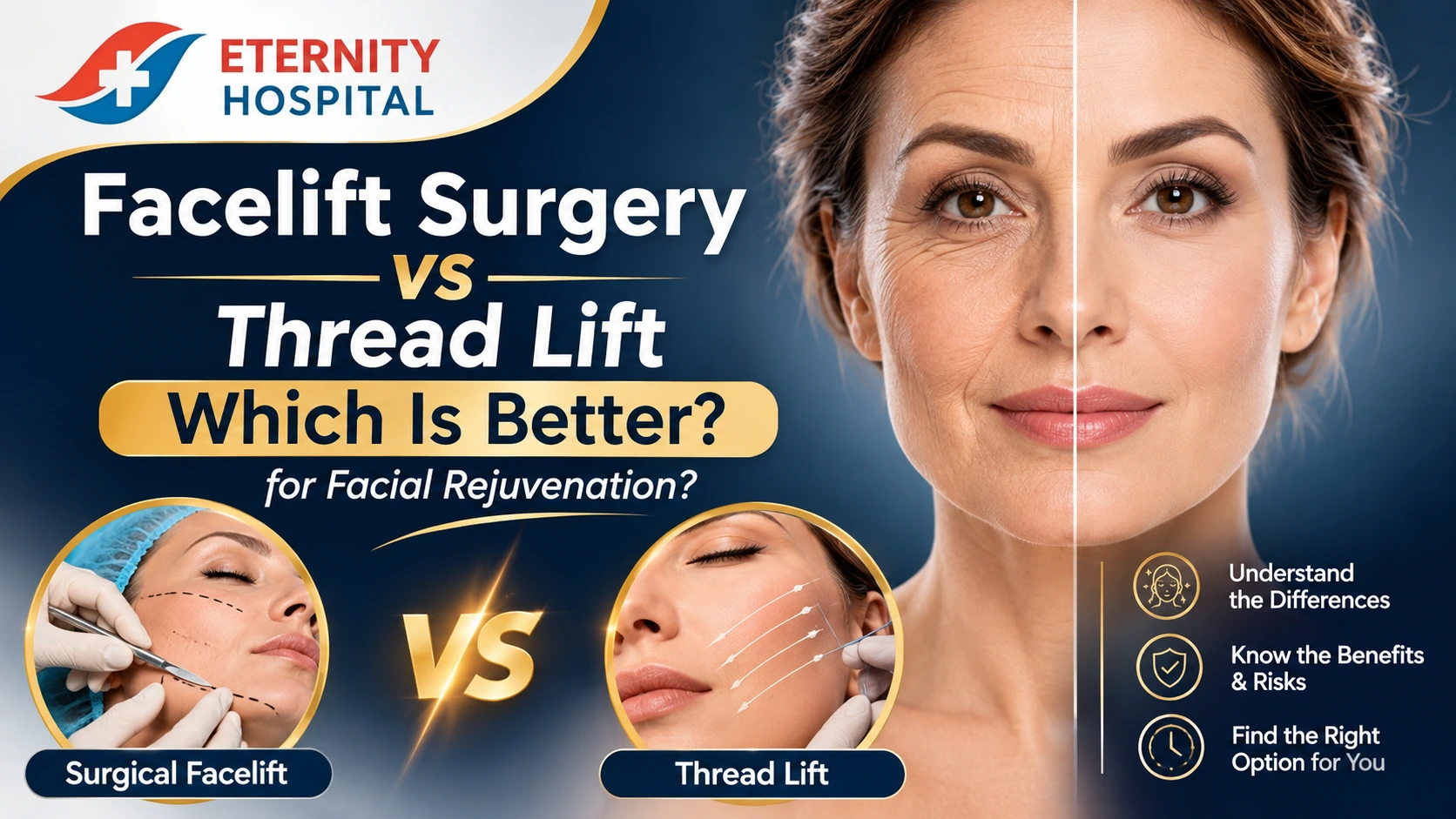
Facelift Surgery vs Thread Lift Facial Ageing is natural, but loose skin, sagging cheeks, deep smile lines, and jowls can make some people feel their appearance no longer reflects how youthful and energetic they feel. If you are exploring facial rejuvenation treatments, you have probably come across two popular options: facelift surgery and thread lift treatment.
But which is better?
The answer depends on your age, skin elasticity, degree of facial sagging, aesthetic expectations, and willingness to undergo surgery. Facelift surgery generally offers more significant and longer-lasting improvement for moderate to advanced facial sagging, while a thread lift provides a temporary, more subtle lifting effect with less downtime.
Neither treatment is automatically right for everyone. Understanding their differences can help you make an informed decision before consulting a qualified plastic surgeon.
At Eternity Hospital in Indirapuram, Ghaziabad, patients can explore facial rejuvenation and plastic surgery consultation options with Dr. Arvind Jain, Senior Aesthetic, Plastic and Reconstructive Surgeon.
1. What Is Facelift Surgery?
A facelift surgery, medically known as rhytidectomy, is a cosmetic surgical procedure designed to improve visible signs of ageing in the face and sometimes the neck. It primarily addresses loose skin, sagging cheeks, jowls, deep folds around the mouth, and loss of jawline definition. Unlike treatments that focus only on the skin’s surface, facelift surgery can address deeper supporting tissues and reposition facial structures to create a more refreshed appearance.
The goal is not to make someone look like a completely different person. A well-planned facelift aims to improve facial contours while respecting the patient’s natural features. The procedure is customised to facial anatomy, skin quality, the degree of sagging, and individual expectations.
American Society of Plastic Surgeons+1
How Does Facelift Surgery Work?
During facelift surgery, the surgeon makes carefully planned incisions, commonly around the ears and sometimes extending into the hairline. Depending on the technique and the patient’s needs, the surgeon may reposition or tighten underlying facial tissues, remove excess skin, and naturally redrape the remaining skin.
Different facelift techniques may be considered:
- Mini facelift: May suit selected patients with relatively mild lower-face sagging.
- Traditional facelift: Addresses more noticeable sagging around the cheeks, jawline, and lower face.
- Deep-plane facelift: A technique that works with deeper facial tissue layers to reposition sagging structures.
- Neck lift with facelift: May be considered when loose neck skin and reduced jawline definition are also concerns.
Not every patient needs the same operation. A qualified plastic surgeon determines the appropriate approach after examining the face and discussing the patient’s medical history and goals.
2. What Is a Thread Lift?
A thread lift is a minimally invasive facial rejuvenation procedure that uses specialised medical threads placed beneath the skin to provide a lifting effect. These threads may have small cones or barbs that help hold and reposition selected facial tissues.
Thread lifts are commonly considered for mild facial sagging, particularly around the cheeks, jawline, and lower face. Depending on the thread material, the threads may gradually dissolve over time. Some absorbable threads are also intended to stimulate collagen-related tissue responses, although the strength and durability of these effects remain areas of ongoing research.
Unlike traditional facelift surgery, a thread lift does not involve the same degree of surgical tissue repositioning or excess skin removal. Its lifting effect is generally more limited and temporary.
DOI+1
How Does a Thread Lift Work?
The procedure generally involves the following stages:
- The treating clinician examines and marks the treatment area.
- Local anaesthesia is commonly used to improve comfort.
- The clinician inserts specialised threads beneath the skin using a needle or cannula.
- The clinician positions the threads to support selected facial tissues.
- The clinician adjusts the threads to achieve the intended lifting effect.
The procedure usually takes less time than a traditional facelift, although the duration depends on the areas treated and the technique used.
Thread lifts are not suitable for every type of facial Ageing. Significant excess skin, advanced jowls, and substantial neck laxity may require a different treatment approach.
3. Facelift Surgery vs Thread Lift – Key Differences
The biggest difference between facelift surgery and thread lift treatment is the extent of correction they can provide.
A facelift is a surgical procedure designed to address more substantial structural changes associated with Ageing. A thread lift offers a less invasive option for selected patients who want a modest lifting effect without undergoing conventional facelift surgery.
Here is a practical comparison:
Comparison
Facelift Surgery
Thread Lift
Procedure type Surgical Minimally invasive
Anaesthesia Usually general or selected anaesthesia techniques Usually local anaesthesia
Main purpose Corrects more significant facial sagging Provides modest tissue lifting.
Skin removal May remove excess skin Does not remove excess skin
Tissue repositioning Can address deeper facial structures Limited mechanical repositioning
Downtime Generally longer Generally shorter
Results More significant and longer-lasting Temporary
Suitable for Moderate to advanced sagging Mild to selected moderate sagging
Scarring Incision scars, usually placed discreetly Small insertion points
Repeat treatment Not routinely required at short intervals Effects may require repeat treatment
Overall correction More comprehensive More limited
Important: The table describes general differences. Actual results, recovery, and suitability vary by surgical technique, thread type, individual anatomy, and the clinician’s assessment.
American Society of Plastic Surgeons+2
4. Benefits of Facelift Surgery
One of the main advantages of facelift surgery is its ability to address several visible signs of facial Ageing in a single procedure. As the face ages, the supporting tissues gradually change, facial fat may shift, and skin elasticity decreases. These changes can create a tired or sagging appearance even when someone feels healthy and energetic.
A facelift can improve the appearance of loose skin around the lower face, reduce prominent jowls, and create better jawline definition. Depending on the surgical plan, the procedure may also address deeper folds and loose neck skin. This makes it an option for people seeking more noticeable improvement than minimally invasive treatments can generally provide.
Another advantage is the potential longevity of the results. Although Ageing continues naturally after surgery, the improvement may remain visible for several years. The exact duration depends on genetics, lifestyle, skin quality, sun exposure, smoking, and the surgical approach.
A facelift can also be combined with other procedures, such as eyelid surgery or a neck lift, when medically and aesthetically appropriate. However, combining procedures requires careful planning because it may affect overall recovery and risk.
American Society of Plastic Surgeons+1
5. Benefits of Thread Lift
Thread lifts offer a different set of advantages, particularly for people who want a less invasive approach to facial rejuvenation.
The procedure generally requires smaller entry points rather than the longer incisions associated with facelift surgery. Many patients can return to routine activities sooner, although bruising, swelling, and tenderness may temporarily affect their daily schedules.
Other potential benefits include:
- A temporary lifting effect around selected facial areas.
- No surgical removal of excess skin.
- Generally shorter initial recovery than facelift surgery.
- A treatment option for selected patients with mild skin laxity.
- Less extensive intervention than a conventional surgical facelift.
However, it is important not to confuse minimally invasive with risk-free. Thread lifts can cause bruising, swelling, dimpling, asymmetry, infection, thread visibility, or thread migration. Results are also less predictable in patients with significant skin laxity.
A 2025 review of absorbable facial thread lifts found immediate improvement in the studies reviewed, but highlighted the lack of strong long-term efficacy data.
PubMed+1
6. Who Is an Ideal Candidate for Each Procedure?
Choosing between a facelift and thread lift should begin with an assessment of facial Ageing rather than age alone. Two people of the same age may have very different skin elasticity, facial fat distribution, and degrees of tissue laxity.
A facelift may be considered for people who:
- Have noticeable sagging around the cheeks and jawline.
- Have prominent jowls or loose facial skin.
- Experience significant neck laxity.
- Want a more substantial and longer-lasting improvement.
- Are medically suitable for surgery and understand the recovery involved.
A thread lift may be considered for people who:
- Have relatively mild facial sagging.
- Want a modest lifting effect.
- Have suitable skin thickness and tissue quality.
- Prefer a minimally invasive procedure.
- Understand that results are temporary and may be limited.
A person with advanced skin laxity may not achieve satisfactory correction through threads alone. Similarly, someone with very mild ageing changes may not need extensive surgery.
During the consultation, the surgeon may assess skin elasticity, facial symmetry, jowl formation, cheek position, neck contours, and overall health. Medical history, medications, smoking habits, and previous cosmetic treatments should also be discussed.
7. How Long Do the Results Last?
Longevity is one of the most important factors when comparing facelift surgery and thread lift treatment.
A surgical facelift generally provides longer-lasting improvement because it addresses underlying tissue changes and excess skin rather than simply creating a temporary mechanical lift. However, it does not stop the natural ageing process.
Many patients retain visible improvement for several years, although the precise duration varies. Genetics, sun exposure, weight changes, smoking and overall skin health can influence how the face ages after surgery.
American Society of Plastic Surgeons+1
Thread lift results are generally shorter-lived. The immediate lifting effect can gradually reduce as the threads dissolve, or the tissues settle. The Association of Cutaneous Surgeons of India Task Force’s 2025 position statement notes that the available evidence supports short-term lifting, while evidence for durable results beyond 6–12 months remains limited.
DOI
Factor
Facelift Surgery
Thread Lift
Initial improvement After surgical recovery Often visible immediately
Long-term effect Several years in many patients Usually temporary
Effect of ageing Ageing continues Ageing continues
Maintenance Individualised Repeat treatment may be considered
Evidence of durability Established surgical procedure More limited long-term evidence
If your priority is a more substantial and durable correction of facial sagging, facelift surgery may be the more appropriate option. If you want a modest temporary improvement, a thread lift may be worth discussing.
8. Recovery Time and Aftercare
Recovery is another major consideration when deciding between these procedures.
Recovery after facelift surgery
Facelift recovery involves more healing than thread lift treatment because surgery affects the skin and underlying tissues. Swelling, bruising, tightness, and temporary discomfort are common during early recovery.
Patients may need initial at-home assistance and should follow their surgeon’s instructions on wound care, sleeping position, activity restrictions, and follow-up appointments. Avoid strenuous exercise and activities that increase facial pressure until the surgeon confirms they are safe.
Most patients need time away from work and social activities, with the exact period depending on the extent of surgery and individual healing. Final results become clearer as swelling gradually settles.
Recovery after thread lift
Thread lift recovery is generally shorter, but patients can still experience bruising, swelling, tenderness, and a pulling sensation. Some may notice dimpling or unevenness during the initial healing period.
Aftercare instructions may include avoiding excessive facial movements, vigorous exercise, facial massage, and pressure on the treated area for the period recommended by the treating clinician.
Recovery factor
Facelift
Thread Lift
Initial healing More extensive Generally less extensive
Swelling Can be more noticeable Usually more limited
Bruising Possible Possible
Work resumption Often requires more time away Often sooner
Follow-up Surgical wound and recovery monitoring Assessment of lifting effect and healing
No single recovery timeline applies to everyone. Your surgeon should provide an individual recovery plan.
9. Risks and Possible Complications
Both procedures have potential risks. A cosmetic treatment does not mean it is free from medical complications.
Possible facelift surgery complications
- Bleeding or haematoma (collection of blood under the skin).
- Infection.
- Scarring.
- Temporary or persistent changes in skin sensation.
- Nerve injury, which can affect facial movement.
- Skin-healing problems.
- Anaesthesia-related complications.
- Asymmetry or dissatisfaction with the cosmetic outcome.
Smoking, certain medical conditions, and poor wound-healing capacity can increase surgical risks. A thorough preoperative assessment is essential.
Possible thread lift complications
- Swelling and bruising.
- Skin dimpling or irregular contours.
- Facial asymmetry.
- Threads becoming visible or palpable.
- Thread migration or extrusion.
- Infection.
- Temporary discomfort or altered sensation.
A systematic review and meta-analysis published in 2021 reported swelling in approximately 35% of cases, skin dimpling in 10%, altered sensation in 6%, thread visibility or palpability in 4%, infection in 2%, and thread extrusion in 2%. These figures come from pooled studies and should not be interpreted as guaranteed risks for an individual patient.
PubMed
A qualified medical professional should explain the specific risks associated with the proposed procedure, thread material, surgical technique, and individual health circumstances.
10. Facelift Surgery vs Thread Lift Cost in India
Cost is another important consideration for patients researching facelift surgery vs thread lift in India.
Generally, a surgical facelift costs more than a thread lift because it involves an operating theatre, surgical expertise, anaesthesia, medical monitoring, and postoperative care. However, you can’t determine the final cost by comparing procedure names alone.
The following factors can influence the price:
Facelift surgery cost factors
- Type and complexity of facelift.
- Surgical technique.
- Anaesthesia requirements.
- Hospital and operating theatre charges.
- Preoperative investigations.
- Whether a neck lift is combined with another procedure.
- Postoperative medicines and follow-up care.
Thread lift cost factors
- Type and material of threads.
- Number of threads required.
- Areas being treated.
- Clinician’s expertise.
- Clinic facilities.
- Follow-up requirements.
Cost consideration
Facelift Surgery
Thread Lift
Initial procedure expense Generally higher Generally lower
Anaesthesia expense Depends on surgical plan Usually lower
Hospital expenses May be applicable Usually limited
Number of treatments Usually one planned operation May require repeat treatment
Long-term expense Depends on individual needs Repeat procedures may add to cost
No universal facelift or thread lift price applies to every patient in India. Patients should request an individualised estimate after medical assessment rather than relying on advertised starting prices.
At Eternity Hospital, patients can discuss their treatment requirements and associated costs during consultation. For information, visit Eternity Hospital’s contact page.
11. Which Procedure Gives More Natural Results?
One common concern among people considering cosmetic facial treatments is whether they will look artificial after the procedure.
Natural-looking results depend more on treatment planning, facial anatomy, technique, and the surgeon’s judgement than on whether the procedure is surgical or non-surgical.
A facelift can provide natural-looking improvement when the surgeon respects the patient’s original facial proportions and avoids excessive skin tightening. The aim is to restore a more refreshed appearance rather than create an unusually tight or stretched face.
A thread lift can also create a subtle improvement in selected patients. However, excessive traction, inappropriate thread placement, or unsuitable patient selection may produce visible dimpling, unevenness, or an unnatural contour.
Before deciding, discuss what you want to improve. Bring photographs that represent your preferred aesthetic direction, but remember that another person’s result cannot predict your own.
12. Can a Thread Lift Replace Facelift Surgery?
No. A thread lift cannot reliably replace facelift surgery for patients with significant facial sagging or excess loose skin.
The two treatments work differently. A thread lift provides limited mechanical support to selected tissues, while facelift surgery can reposition deeper structures and remove excess skin.
For example, someone with mild cheek laxity may be suitable for a thread lift after assessment. However, someone with substantial jowls, loose skin around the jawline, and significant neck sagging may need surgery for meaningful improvement.
Expectations also differ. A patient choosing a thread lift should understand that it is not a non-surgical equivalent of a full facelift.
Previous thread lift treatment does not automatically prevent someone from having facelift surgery later. However, the surgeon should know about previous threads, their material, placement, and any complications because these factors may influence surgical planning.
PubMed+1
13. Myths vs Facts About Facial Rejuvenation
Myth
Fact
A thread lift gives the same results as facelift surgery. A thread lift generally provides a more limited and temporary lifting effect.
Facelift surgery stops Ageing. Natural Ageing continues after surgery.
Thread lifts are completely risk-free. They can cause infection, dimpling, asymmetry, and other complications.
Only older people need facelifts. Suitability depends on facial anatomy, skin laxity and health, not age alone.
A facelift always makes the face look tight. Proper surgical planning aims to preserve natural facial proportions.
More threads always mean better results. More threads have not consistently shown better long-term lifting outcomes.
DOI+2
14. How to Choose the Right Facial Rejuvenation Treatment
Before selecting a facial rejuvenation procedure, take time to understand what is causing the changes you want to address.
Are you concerned about loose skin, deep folds, reduced cheek volume, jowls, or neck laxity? These concerns may require different treatments. For example, a facelift may address sagging tissues, whereas fillers may be considered for selected areas of volume loss. Eyelid surgery may be more appropriate when the main concern involves excess eyelid skin or under-eye bags.
Here are five important points to discuss with your surgeon:
- Your main concern: Identify the facial areas you want to improve.
- Expected results: Understand what each treatment can realistically achieve.
- Medical suitability: Discuss your health, medications, and previous procedures.
- Recovery requirements: Consider your work schedule and ability to follow aftercare instructions.
- Long-term expectations: Ask how results may change with Ageing and whether additional treatment may be required.
A good consultation should explain both the advantages and limitations of each option. You should never feel pressured to select a particular procedure.
15. Why Consult a Qualified Plastic Surgeon at Eternity Hospital?
Choosing the right medical professional is an important part of facial rejuvenation. Whether you are considering a facelift or a less invasive treatment, base your decision on a proper assessment of facial anatomy, skin quality, medical history, and aesthetic goals.
Eternity Hospital provides plastic and cosmetic surgery services in Indirapuram, Ghaziabad.
The hospital’s website lists facelift services, including surgical facelift procedures, and features Dr. Arvind Jain, Senior Aesthetic, Plastic and Reconstructive Surgeon.
Dr. Arvind Jain’s listed qualifications include:
- MBBS
- MS
- MCh Plastic Surgery
His professional profile describes training at institutions including AIMS Kochi, Safdarjung Hospital, RGCI, Max Super Speciality Hospital Saket and Bombay Hospital Mumbai.
Expert Plastic Surgeon in Indirapuram, Ghaziabad+1
Patients considering facial rejuvenation can discuss their concerns, available treatment options, possible complications, and expected recovery.
Explore the following hospital resources:
- Facelift Services at Eternity Hospital
- Dr. Arvind Jain – Professional Profile
- About Eternity Hospital
- Contact and Appointment Information
16. Frequently Asked Questions
1. Which is better, facelift surgery or thread lift?
Facelift surgery is generally more effective for significant facial sagging, loose skin, and prominent jowls. A thread lift may suit mild sagging when someone wants a temporary lifting effect without conventional surgery. The better choice depends on individual facial anatomy and treatment goals.
2. How many years does a facelift last?
Facelift results can remain visible for several years. Duration varies depending on the surgical technique, genetics, skin quality, lifestyle, and natural Ageing. Surgery does not stop the ageing process.
3. Is a thread lift painful?
A thread lift is generally performed using local anaesthesia, so discomfort during the procedure is usually controlled. Some patients experience tenderness, swelling, bruising, or a pulling sensation afterwards.
4. Can I get a facelift after having a thread lift?
Yes, previous thread lift treatment does not automatically rule out future facelift surgery. However, you should tell your plastic surgeon what type of threads were used, when the procedure was performed, and whether you experienced any complications.
5. What is the best age for facelift surgery?
There is no fixed ideal age for facelift surgery. The decision depends on facial sagging, skin elasticity, overall health, and individual expectations. A medical assessment is more useful than choosing treatment based on age alone.
17. Conclusion
When comparing facelift surgery vs thread lift, the right treatment depends on the extent of facial Ageing and the type of results you want.
Facelift surgery is generally the more suitable option for people experiencing significant sagging, loose skin, prominent jowls, and changes in the jawline. It offers more comprehensive, longer-lasting improvement, although it involves surgery, recovery time, and potential complications.
A thread lift may suit selected individuals with mild facial sagging who prefer a minimally invasive treatment and understand its limitations. Its results are generally temporary, and it cannot provide the same degree of correction as a surgical facelift.
Rather than choosing a procedure because it is popular or less invasive, consult a qualified plastic surgeon who can evaluate your facial structure and recommend an appropriate approach.
Considering facial rejuvenation in Ghaziabad or Indirapuram?
At Eternity Hospital, Indirapuram, patients can consult Dr. Arvind Jain, Senior Aesthetic, Plastic and Reconstructive Surgeon, to understand facelift surgery and suitable facial rejuvenation options.
Make an informed decision based on medical advice, realistic expectations, and your individual needs.