

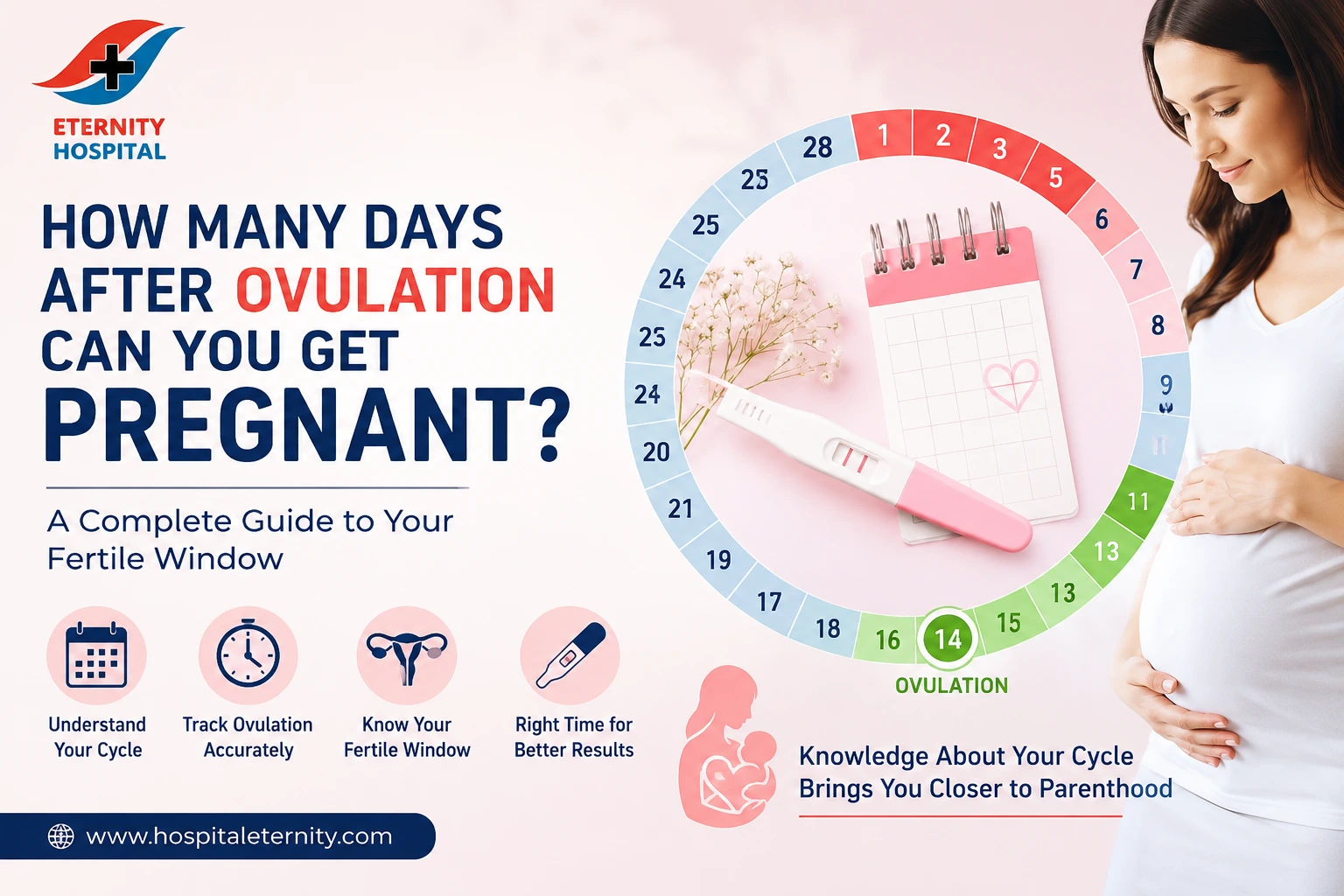
IIf you are trying to conceive, timing matters—but it is not as simple as choosing one “perfect” day. An egg usually remains available for fertilization for only about 12–24 hours after ovulation, while sperm can remain functional in the female reproductive tract for several days. According to the American College of Obstetricians and Gynecologists (ACOG), pregnancy can occur from intercourse during the five days before ovulation through about one day after ovulation.
So, how many days after ovulation can you get pregnant? The practical answer is usually within about 24 hours after ovulation, because the egg has a short lifespan. However, pregnancy may result from sex that happened several days before ovulation because sperm can survive long enough to meet the egg when it is released.
Understanding this distinction makes fertility tracking much easier. It also explains why counting backward from your expected period is useful but cannot always identify the exact day you ovulated.
The Short Answer
Pregnancy can generally occur if sperm meets the egg within the egg’s short fertile lifespan after ovulation. ACOG states that an egg can survive in the fallopian tube for approximately 24 hours after ovulation, while sperm can survive for around three days and sometimes up to five days. This creates a fertile window that extends beyond the actual day of ovulation.
The important point is that conception does not normally occur several days after ovulation if ovulation has definitely already happened and the egg is no longer viable. What often confuses is the difference between intercourse, fertilization, implantation, and a positive pregnancy test.
Event Approximate timing
Ovulation Egg is released from the ovary
Egg remains viable About 12–24 hours after ovulation
Sperm survival About 3 days, sometimes up to 5 days
Fertilization Usually around ovulation when viable sperm meets the egg
Early implantation process Begins several days after fertilization
More established implantation Approximately 6–12 days after ovulation
Pregnancy test detects hCG after implantation begins
These are biological ranges rather than guarantees for every individual. The exact timing can vary because ovulation itself may occur earlier or later than predicted.
Fertilization vs. Implantation
Fertilization is when sperm and egg join, usually in the fallopian tube. Implantation happens later, when the developing embryo attaches to the lining of the uterus. A pregnancy test does not detect the sperm meeting the egg; it detects human chorionic gonadotropin (hCG) associated with pregnancy after implantation begins.
That distinction is especially useful if you are counting days after ovulation. Someone may say, “I had sex five days after ovulation and became pregnant,” but if ovulation was estimated rather than confirmed, the actual ovulation date may have been different.
What Happens After Ovulation?
Ovulation is the point in the menstrual cycle when an ovary releases an egg. Once released, the egg travels into the fallopian tube, where fertilization can occur if viable sperm are present. ACOG explains that the egg’s lifespan is short, which is why the timing of intercourse relative to ovulation matters so much when trying to conceive.
Think of ovulation as a very short appointment window. The egg is available for a limited period, but sperm can arrive and remain in the reproductive tract before the egg is released. This is why intercourse before ovulation can still lead to pregnancy.
How Long the Egg Survives
The egg generally remains capable of fertilization for approximately 12–24 hours after ovulation. After this period, fertilization becomes unlikely because the egg is no longer viable.
This means that if ovulation truly occurred on Monday morning, the opportunity for fertilization from that egg is mainly concentrated around Monday and potentially into Tuesday. It would not normally extend several days beyond ovulation.
This is also why a person cannot reliably increase the chance of pregnancy by waiting several days after confirmed ovulation to have intercourse. The more useful strategy is to have sperm present before or around ovulation.
How Long Sperm Can Survive
Sperm have a much longer potential survival time than an unfertilized egg. ACOG reports that sperm can survive inside the reproductive tract for about three days and sometimes as long as five days.
This creates an important biological advantage for conception. If intercourse occurs a few days before ovulation, sperm may still be present when the egg is released. The National Institute of Child Health and Human Development (NICHD) similarly notes that sperm can live for up to five days in the female reproductive tract.
The reproductive environment influences the quality and survival of sperm, so “five days” should not be interpreted as a guaranteed survival period for every sperm cell.
Your Fertile Window Explained
The fertile window is broader than the brief period when the egg itself remains viable. ACOG describes pregnancy as possible from approximately five days before ovulation through one day after ovulation. The highest likelihood is around the days immediately surrounding ovulation because viable sperm and the newly released egg are more likely to overlap.
For someone trying to conceive, this means there is usually no need to focus exclusively on the exact day of ovulation. Having intercourse every day or every other day during the fertile window can help cover the period when ovulation occurs. ACOG specifically describes the fertile window as roughly six days and recommends regular intercourse during this period for people trying to become pregnant.
Why Pregnancy Can Happen Before Ovulation
This is one of the most important concepts in fertility. Suppose intercourse occurs on Wednesday and ovulation occurs on Saturday. Because sperm can survive for several days, sperm from Wednesday may still be present when the egg is released on Saturday.
That means sex before ovulation can be more relevant to conception than sex several days after ovulation. The National Institutes of Health explains that sperm can remain functional for up to five days, while the egg has a much shorter fertilizable period.
Can You Get Pregnant One Day After Ovulation?
Yes, pregnancy can still be possible around one day after ovulation, particularly if the timing of ovulation is uncertain. ACOG includes approximately one day after ovulation within the possible fertile range because an egg may remain viable for around 24 hours.
However, the probability generally falls rapidly once the egg’s viable period has passed. If ovulation has been accurately confirmed and more than 24 hours have passed, conception from that particular egg becomes unlikely.
This is why fertility tracking should focus on identifying the fertile window, rather than assuming that one calendar date is always the exact ovulation date.
When Does Implantation Happen?
After fertilization, the developing embryo travels through the fallopian tube toward the uterus. Implantation is a separate step from fertilization and occurs later.
According to NICHD, the embryo begins attaching to the uterine lining around five to six days after ovulation and becomes more firmly implanted between approximately six and 12 days after ovulation. Implantation is associated with the release of hCG, the hormone detected by pregnancy tests.
Implantation Timeline
A simplified timeline looks like this:
Ovulation → fertilization if sperm and egg meet → embryo develops while moving toward the uterus → implantation → increasing hCG → pregnancy test may become positive.
This explains why you cannot expect a pregnancy test to become positive immediately after intercourse or immediately after ovulation. Even if fertilization occurs, several biological steps still need to happen before hCG can be detected.
It also explains why symptoms alone are not a reliable way to determine whether conception occurred. Early pregnancy symptoms can overlap with normal hormonal changes that happen before a menstrual period.
When Should You Take a Pregnancy Test?
If you are wondering whether you conceived after ovulation, taking a pregnancy test too early can create unnecessary confusion. Pregnancy tests detect hCG, which becomes available after implantation begins rather than immediately after fertilization.
A test taken very early may therefore be negative even when pregnancy eventually develops. If your period does not arrive as expected, repeating the test according to the test manufacturer’s instructions or discussing testing with a healthcare professional can provide clearer guidance.
Early Testing and False-Negative Results
A negative pregnancy test does not always mean that conception did not occur when testing is performed very early. The timing of ovulation, implantation, and hCG production differs among individuals.
For this reason, avoid interpreting a single early negative result as definitive if your period is still due. If you have irregular cycles, estimating the appropriate testing date can be particularly difficult because the assumed ovulation date may be inaccurate.
ACOG’s 2026 clinical guidance also highlights that hCG results need appropriate clinical interpretation in situations where pregnancy status is uncertain, or hCG remains unexpectedly elevated.
How to Identify Ovulation More Accurately
Calendar tracking can be useful, but it is an estimate. ACOG explains that ovulation typically occurs about 14 days before the start of the next menstrual period, rather than necessarily occurring on day 14 of every cycle.
For example, someone with a 28-day cycle may ovulate around day 14, while someone with a 35-day cycle may ovulate closer to day 21. But even these calculations are not guarantees because cycle length and ovulation timing can change.
Ovulation Predictor Kits
Ovulation predictor kits detect a rise in luteinizing hormone (LH) in urine. According to ACOG, a positive LH test generally suggests that ovulation may occur within approximately 24–48 hours.
Other fertility signs include changes in cervical mucus and basal body temperature. Cervical mucus often becomes clearer, thinner, and more stretchy around the fertile period, while a sustained rise in basal body temperature can help confirm that ovulation has occurred rather than predict it in advance.
Tracking method What it tells you Main limitation
Period calendar Estimates fertile days Cannot confirm exact ovulation
Cervical mucus Helps identify approaching fertility Requires consistent observation
LH ovulation test Indicates an LH surge Does not guarantee ovulation occurred
Basal body temperature Helps confirm ovulation retrospectively Usually does not predict ovulation early enough
Clinical testing Can provide more detailed assessment May require professional evaluation
If cycles are irregular or conception has been difficult, a gynaecologist can recommend a more appropriate fertility assessment instead of relying entirely on home tracking.
Factors That Can Change Ovulation Timing
Ovulation is not necessarily identical every month. Stress, illness, changes in routine, certain health conditions, medications, breastfeeding, and hormonal disorders can affect menstrual patterns and ovulation.
This matters because a calculation such as “I ovulate on day 14” may be too simplistic. ACOG explains that ovulation is generally about 14 days before the next period, but cycle length can vary substantially between individuals.
Irregular Menstrual Cycles
If your periods are irregular, predicting ovulation from the calendar becomes less reliable. For example, if your cycles vary from 26 to 35 days, the likely ovulation date may shift considerably from one cycle to another.
Conditions affecting ovulation can also influence fertility. ACOG identifies ovulation problems as a common cause of female infertility and notes that age, lifestyle, health conditions, and other reproductive factors can affect fertility.
If you have irregular periods and are actively trying to conceive, discussing your cycle pattern with a qualified gynaecologist can help determine whether additional evaluation is appropriate.
Common Misconceptions About Conception
One common misconception is that pregnancy can occur several days after ovulation simply because intercourse happened after the estimated ovulation date. If ovulation was accurately identified and the egg is no longer viable, fertilization cannot normally occur from that egg.
Another misconception is that every person ovulates on day 14. That assumption comes from the traditional 28-day cycle example, but ACOG emphasizes that ovulation typically occurs about 14 days before the next period so that the actual cycle day can vary.
A third misconception is that a pregnancy test can immediately confirm fertilization. It cannot. The test detects hCG after implantation begins, so there is naturally a delay between ovulation, possible fertilization, implantation, and detectable pregnancy.
Finally, pregnancy is not guaranteed simply because intercourse occurs during the fertile window. Several biological factors influence conception, including sperm health, ovulation, reproductive anatomy, age, and overall fertility.
When to Speak With a Doctor
Consider speaking with a qualified gynaecologist if you have been trying to conceive without success, particularly if you have irregular periods, very painful periods, known reproductive health concerns, or other reasons to suspect an ovulation or fertility problem.
ACOG recommends infertility evaluation after 12 months of regular unprotected intercourse for people under 35, after 6 months for those older than 35, and advises people older than 40 to discuss evaluation with an obstetrician-gynaecologist promptly.
For patients in Ghaziabad, Indirapuram, Siddharth Vihar, Noida, and surrounding Delhi-NCR areas, a consultation with a qualified gynaecologist can help distinguish normal cycle variation from a problem that may need investigation. The right evaluation depends on your individual menstrual history, age, reproductive goals, and medical background.
Practical Steps If You Are Trying to Conceive
If pregnancy is your goal, focus less on finding one magical day and more on covering the fertile window.
- Track your menstrual cycle consistently for several months.
- Watch for fertile cervical mucus, particularly clear, slippery, stretchy discharge.
- Consider an LH ovulation test if you want additional information about approaching ovulation.
- Have intercourse every day or every other day during the fertile window, rather than waiting only for the estimated ovulation day. ACOG supports regular intercourse across the fertile window.
- Do not rely exclusively on calendar calculations if your periods are irregular.
- Take a pregnancy test at an appropriate time rather than testing immediately after intercourse or ovulation.
- Seek medical advice when indicated, especially if conception is taking longer than expected or cycles are significantly irregular.
The goal is not to make conception feel like a complicated mathematical exercise. Instead, understanding the biology helps you make better timing decisions without assuming that every cycle follows the same script.
Conclusion
The most important takeaway is simple: pregnancy is most likely when viable sperm are present around ovulation. An egg generally remains viable for about 12–24 hours after ovulation, while sperm can survive for several days, which is why the fertile window starts before ovulation rather than after it.
If you are trying to conceive, tracking ovulation and having regular intercourse during the fertile window is generally more useful than focusing on a single day. If your cycles are irregular or pregnancy is taking longer than expected, a qualified gynaecologist can help identify whether further evaluation is appropriate.