

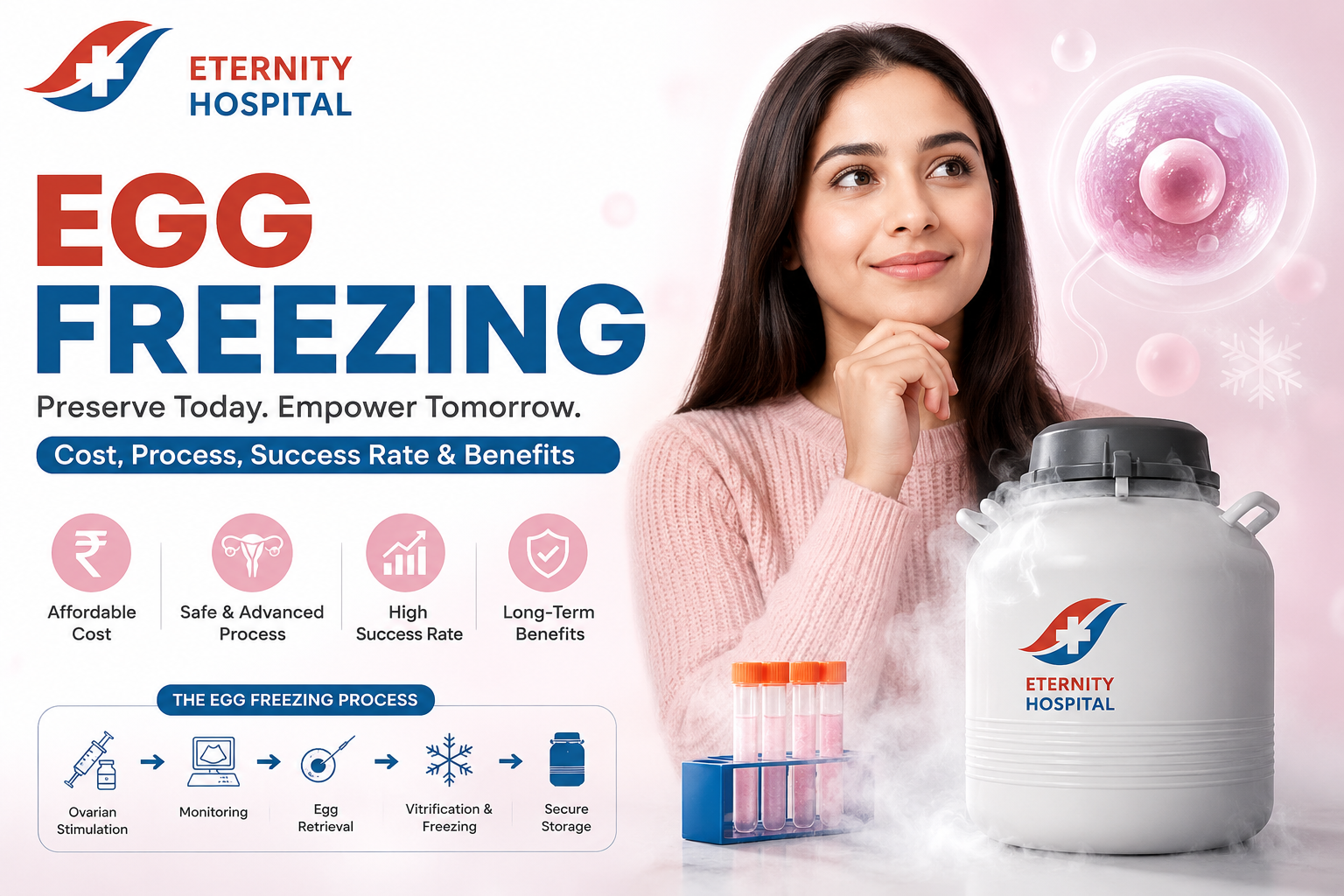
Egg freezing, medically called oocyte cryopreservation, has become an important fertility-preservation option for women who may not be ready to have children today but want to keep the possibility open for the future. Modern vitrification technology has made egg freezing considerably more effective than older slow-freezing methods, but it is important to understand one thing clearly: freezing eggs preserves an opportunity for future pregnancy; it does not guarantee a baby.
The decision can be relevant for several reasons. Some women want to delay pregnancy because of education, career, relationships, or personal circumstances, while others need fertility preservation before medical treatment that may affect ovarian function. The age at which eggs are frozen, the number of mature eggs obtained, ovarian reserve, laboratory quality, and the woman’s future reproductive circumstances can all influence the eventual outcome.
What Is Egg Freezing and Why Is It Done?
Egg freezing involves stimulating the ovaries to produce multiple mature eggs, retrieving those eggs through a minimally invasive procedure, rapidly freezing suitable mature eggs, and storing them for possible future use. Unlike embryo freezing, the eggs are not fertilised before storage, which means you do not need to decide today which sperm will eventually be used.
The American Society for Reproductive Medicine recognises mature oocyte cryopreservation as an established fertility-preservation technique. ASRM also emphasises that age at vitrification and the number of oocytes cryopreserved are important predictors of future success. This makes egg freezing less like putting fertility “on pause” and more like preserving reproductive potential at a particular point in time.
How Egg Freezing Preserves Fertility
A woman’s egg quantity and egg quality generally decline with increasing age. Egg freezing cannot stop that natural biological process, but it can preserve eggs collected at a younger age for possible use later.
The important distinction is that freezing does not make an older egg biologically younger. Instead, it stores the eggs at the age at which they were collected. When those eggs are eventually thawed, fertilised and developed into embryos, their potential is influenced substantially by the age and quality of the eggs at the time they were frozen.
This is why fertility specialists usually discuss egg freezing sooner rather than later when a woman is seriously considering it. HFEA describes egg freezing as a way of attempting to preserve fertility and specifically warns that it should not be viewed as an insurance policy or guarantee of future pregnancy.
Who Should Consider Egg Freezing?
Egg freezing can be considered by women who want to preserve reproductive options for the future. However, the decision should be individualised rather than based solely on age, social circumstances or a single blood test.
There are two broad situations in which egg freezing may be discussed: medical fertility preservation and planned or elective fertility preservation. Medical preservation may be particularly important when a woman is preparing for chemotherapy, radiotherapy or another treatment that could impair ovarian function. In such circumstances, fertility preservation may need to be discussed quickly because treatment timing can matter.
Elective egg freezing may be considered by someone who is not ready to pursue pregnancy but is concerned about future fertility decline. HFEA lists delayed childbearing, medical treatment that may affect fertility, and certain other circumstances among reasons women may consider fertility preservation.
Medical and Elective Reasons for Egg Freezing
Situation: Why egg freezing may be considered
Cancer treatment Some cancer treatments can damage ovarian function
Risk of premature ovarian insufficiency Preservation may be considered before ovarian reserve declines substantially
Delaying pregnancy Provides an additional reproductive option for women not ready for pregnancy
Certain ovarian conditions or surgery Treatment may affect available ovarian tissue or egg reserve
Personal circumstances Some women choose planned fertility preservation because they are not ready for pregnancy
Egg freezing is not automatically necessary simply because someone reaches a particular age. A fertility specialist may consider menstrual history, ovarian reserve, medical history, ultrasound findings, previous surgery, and reproductive goals before advising whether the procedure is appropriate.
When Is the Best Age to Freeze Your Eggs?
There is no single age that guarantees success, but a younger age at egg freezing is generally associated with better outcomes. This is because egg quality tends to decline with age, and chromosomal abnormalities become more common as eggs age.
ASRM’s evidence review found that available data, although limited, generally show improved ongoing pregnancy and live birth outcomes when planned egg cryopreservation is performed at younger rather than older ages. In one study reviewed by ASRM, clinical pregnancy was 60.2% among women under 38 compared with 43.9% among women aged 38 or older, although the study population and methodology mean these figures should not be treated as an individual prediction.
Why Age Matters for Egg Quality
Egg quantity and egg quality are different concepts. Ovarian reserve tests can provide information about the expected number of eggs that may be retrieved, but they cannot perfectly predict whether a particular frozen egg will ultimately produce a live birth.
This distinction is extremely important. A woman may have a reasonable ovarian reserve but still face age-related changes in egg quality. Conversely, another woman may have a lower ovarian reserve but produce several mature eggs in a stimulation cycle.
For this reason, fertility evaluation should not rely on AMH or another ovarian reserve measurement alone. The goal is to understand the overall reproductive picture and then discuss realistic expectations.
Egg Freezing Process Step by Step
Egg freezing generally follows the early stages of an IVF treatment cycle. HFEA states that the process commonly takes approximately two to three weeks, although the exact schedule varies between patients and clinics.
The process usually includes fertility assessment, ovarian stimulation, ultrasound monitoring, a trigger injection, egg retrieval, and laboratory vitrification. Medication doses and treatment protocols are individualised according to ovarian response and clinical circumstances.
Ovarian Stimulation and Monitoring
During ovarian stimulation, fertility medicines containing gonadotropins are used to encourage the ovaries to develop several follicles rather than the single dominant follicle typically seen during a natural cycle.
The response is monitored using ultrasound examinations and, where appropriate, blood tests. Monitoring helps the fertility team determine how the ovaries are responding and when the follicles have reached an appropriate stage for egg maturation.
The purpose is not simply to collect as many eggs as possible at any cost. The objective is to obtain an appropriate number of mature eggs while maintaining patient safety and reducing the risk of complications such as ovarian hyperstimulation syndrome.
Egg Retrieval and Vitrification
When the follicles are ready, a final medication called a trigger is administered to support final egg maturation. Egg retrieval is then performed using ultrasound guidance, usually under sedation or anaesthesia.
A fine needle is passed through the vaginal wall into the ovarian follicles, and follicular fluid containing eggs is aspirated. The embryology laboratory then identifies the eggs and determines which are mature and suitable for freezing.
Modern egg freezing commonly uses vitrification, a rapid freezing method designed to minimise ice-crystal formation. HFEA reports that vitrification has become more successful than older slow-cooling approaches and is now widely used.
How Many Eggs Should Be Frozen?
No universally correct number of eggs guarantees a future live birth. The number needed depends heavily on the woman’s age when the eggs are frozen, the proportion that are mature, laboratory performance, egg survival after warming, fertilisation, embryo development and subsequent embryo-transfer outcomes.
ASRM specifically states that evidence is insufficient to prescribe one absolute number of eggs that every woman at a particular age should freeze. Its guideline discusses modelling suggesting that approximately 14 mature oocytes for women aged 30–34, 15 for ages 35–37 and 26 for ages 38–40 could correspond to a 70% estimated chance of one live birth in a particular model, but these are estimates rather than guarantees or universal targets.
That distinction matters when planning treatment. Some women may obtain the desired number of mature eggs in one stimulation cycle, while others may need more than one cycle. Your doctor may therefore recommend a target based on age, ovarian reserve, previous response, and reproductive goals rather than simply promising a fixed number.
Egg Freezing Success Rate
The phrase “egg freezing success rate” can be misleading because success is not one single event. There are several stages between an egg being frozen and a baby being born: the egg must survive warming, fertilise, develop into an embryo, implant, and continue through pregnancy.
ASRM notes that evidence for predicting live birth after planned egg freezing remains limited. Its guideline concludes that live birth outcomes appear better when eggs are frozen at a younger age, but there is insufficient evidence to give every woman a guaranteed probability of live birth based solely on the number of eggs stored.
HFEA similarly advises patients to look carefully at clinic-specific outcomes and warns that egg freezing is not a guarantee of future pregnancy. It also notes that newer freezing technology has changed outcomes, meaning older studies should not automatically be compared with modern vitrification results.
Factors That Influence Success
Several factors can affect the eventual outcome:
- Age at egg freezing
- Number of mature eggs stored
- Egg quality
- Ovarian reserve and response to stimulation
- Laboratory experience with vitrification and warming
- Egg survival after thawing
- Fertilisation and embryo-development rates
- Sperm quality when the eggs are eventually used
- Uterine and maternal health at the time of pregnancy
A clinic’s “egg survival rate” is therefore not the same as its “live birth rate.” When comparing fertility centres, ask for outcomes that match your age group and treatment circumstances.
Egg Freezing Cost in India
The egg freezing cost in India varies significantly according to the city, fertility centre, medication requirements, laboratory services, anaesthesia or sedation, number of cycles, and storage arrangements.
Current published information from Apollo Hospitals places the typical egg-freezing cost in India at approximately ₹1 lakh to ₹2.5 lakh per cycle, while a current Indira IVF estimate places Delhi NCR costs around ₹1.5 lakh to ₹2.5 lakh per cycle. These are indicative figures rather than a quotation for any individual patient.
The final financial commitment can be higher because medication, investigations, additional stimulation cycles, and long-term storage may be charged separately.
What Is Included in the Cost?
May cost component be included? Why it matters
Initial consultation Sometimes Establishes treatment suitability
Fertility testing Variable May include blood tests and ultrasound
Stimulation medicines Often separate Medication requirements vary considerably
Ultrasound monitoring Variable Multiple monitoring visits may be required
Egg retrieval Usually part of treatment package Requires clinical and anaesthesia support
Laboratory freezing Usually included Covers processing and vitrification
Storage Often separate after an initial period Recurring expense
Future thawing and IVF/ICSI Usually separate Required when frozen eggs are eventually used
Before beginning treatment, ask the clinic for a written cost estimate covering the initial cycle, medicines, monitoring, retrieval, laboratory charges, and storage. Also ask what happens financially if a second stimulation cycle is recommended.
Benefits of Egg Freezing
The biggest benefit of egg freezing is that it can provide an additional reproductive option for the future. Instead of deciding pregnancy entirely around the current stage of life, a woman may preserve some eggs for potential later use.
Another advantage is that frozen unfertilised eggs do not require a sperm source at the time of freezing. ASRM notes that mature oocyte cryopreservation gives the patient control over the future choice of sperm source and disposition of the stored eggs.
Egg freezing can also be particularly valuable when medical treatment threatens fertility. In such cases, fertility preservation may allow a patient to address reproductive goals before starting treatment that could reduce ovarian function.
The emotional benefit can be meaningful as well. Some women experience reassurance from having preserved eggs, although that reassurance should not become a false expectation that future pregnancy is guaranteed.
Risks and Limitations of Egg Freezing
Egg freezing is generally considered an established fertility-preservation technique, but it is still a medical procedure involving ovarian stimulation, medication and egg retrieval.
Fertility medicines can cause side effects such as abdominal bloating, breast tenderness, mood changes and discomfort. A more serious complication is ovarian hyperstimulation syndrome (OHSS), which can occasionally require medical treatment. Egg retrieval itself is an invasive procedure and carries uncommon risks such as bleeding, infection or injury to nearby structures.
The most important limitation is not necessarily the freezing procedure itself—it is that not every frozen egg will eventually result in a baby. HFEA identifies treatment failure as a major risk and advises patients to understand that egg freezing is not an insurance policy for future fertility.
Individual results can vary substantially, so a fertility specialist should assess your medical history and provide personalised counselling.
Egg Freezing vs Embryo Freezing
Egg and embryo freezing are related but different fertility-preservation strategies.
With egg freezing, unfertilised eggs are stored. With embryo freezing, eggs are fertilised with sperm first and resulting embryos are cryopreserved. Embryo freezing may provide more information about the reproductive material available because the eggs have already passed through fertilisation and embryo-development stages, but it requires sperm and involves decisions regarding embryo storage and future use.
FeatureEgg FreezingEmbryo Freezing
Eggs fertilised before freezing No Yes
Sperm required at freezing stage No Yes
Future sperm source Can be selected later Already used
Fertility preservation Yes Yes
Main advantage Greater reproductive flexibility Embryos have already been created.
Decision-making More flexible for some patients Requires decisions about embryo creation.
Suitable choice Depends on individual circumstances Depends on individual circumstances.
Neither approach is automatically better for everyone. The appropriate option depends on age, fertility status, relationship circumstances, medical treatment, personal preferences and reproductive plans.
How Long Can Frozen Eggs Be Stored?
Frozen eggs are maintained at extremely low temperatures using specialised cryostorage systems. The biological concept is that cryopreservation substantially slows cellular processes, allowing eggs to remain stored until they are needed.
However, the legal and administrative rules governing storage duration differ by country and jurisdiction. Clinics may also have their own consent, renewal and storage policies.
HFEA advises patients to maintain updated contact details and keep track of consent requirements because storage arrangements involve ongoing legal and administrative responsibilities.
When considering egg freezing in India, ask the fertility centre specifically about its storage agreement, annual storage charges, renewal process, documentation and what happens if you later decide not to use the eggs.
What Happens When You Want to Use Frozen Eggs?
When you decide to use your frozen eggs, they are warmed in the embryology laboratory. The eggs that survive warming are then fertilised, usually using intracytoplasmic sperm injection (ICSI), in which an individual sperm is injected directly into an egg.
If fertilisation occurs, the resulting embryo is cultured in the laboratory. Depending on the treatment plan, an embryo may then be transferred into the uterus.
HFEA explains that eggs that have been frozen and subsequently thawed generally require ICSI because the freezing process can alter the outer layer of the egg, making natural sperm penetration more difficult.
This means the original egg-freezing cost is only one part of the potential future treatment expense. A patient may later need thawing, ICSI, embryo culture, medications, and embryo transfer.
Recovery After Egg Retrieval
Egg retrieval is usually a short procedure, but it is normal to experience some temporary discomfort afterward. Mild abdominal cramping, bloating, tiredness, or light vaginal spotting may occur.
Apollo Hospitals states that many patients return to normal activities within a few days, with the immediate recovery period commonly around 24–48 hours, although individual recovery can differ.
Your clinic will provide specific instructions regarding activity, medication, and warning signs. Severe abdominal pain, significant bleeding, breathing difficulty, rapid weight gain, or other concerning symptoms should not be ignored and require prompt medical attention.
Common Misconceptions About Egg Freezing
One common misconception is that frozen eggs guarantee future fertility. They do not. The technology provides an opportunity to preserve eggs, but future success depends on multiple biological and treatment factors.
Another misconception is that a woman can freeze eggs at any age with similar results. Age at freezing matters because egg quality changes over time. The purpose of egg freezing is therefore not simply to store eggs indefinitely; it is to preserve eggs when their potential is relatively better.
Some women also assume that ovarian reserve testing can tell them exactly how many eggs they need to freeze. Tests such as AMH and antral follicle count can help clinicians estimate ovarian response, but ASRM states that there is insufficient evidence to use ovarian reserve testing independently of age to predict live birth after planned egg freezing.
Finally, freezing a large number of eggs does not automatically eliminate uncertainty. The quality of the eggs, laboratory performance, and eventual embryo development remain important.
Questions to Ask Before Choosing Egg Freezing
A consultation becomes much more useful when you arrive with specific questions. Instead of asking only “What is the success rate?”, ask the doctor to explain the complete pathway from stimulation to potential live birth.
Consider asking:
- How does my age affect the expected outcome?
- What does my ovarian reserve testing suggest about egg yield?
- How many mature eggs might reasonably be targeted in my situation?
- What are the clinic’s age-specific warming, fertilisation and live birth outcomes?
- What is included in the quoted egg-freezing cost?
- Could I need more than one stimulation cycle?
- How much does annual egg storage cost?
- What are the risks of ovarian stimulation and egg retrieval for me?
- What will happen when I eventually want to use the eggs?
- What alternatives, including embryo freezing, should I consider?
These questions help shift the discussion from marketing claims to measurable clinical information.
Choosing Fertility Care in Ghaziabad and Delhi NCR
If you are researching egg freezing, fertility preservation, or reproductive health care in Ghaziabad, Indirapuram, or the wider Delhi NCR region, the first step should be a consultation with a qualified fertility or gynaecology professional who can assess your individual situation.
Eternity Hospital in Indirapuram, Ghaziabad provides gynaecology and obstetrics services, including fertility-related care, reproductive health management, and personalised treatment planning. Its published information states that the department provides fertility assessments, fertility treatments, and reproductive-health services, while Dr. Rashmi Jain is listed as a Senior Consultant in Gynaecology and Obstetrics with experience in infertility management and related women’s-health care.
The hospital’s website also provides information about women’s healthcare services in Ghaziabad and Indirapuram, including infertility treatment and reproductive-health concerns.
For someone considering egg freezing, the most useful consultation is one that focuses on your age, ovarian reserve, medical history, treatment goals, expected egg yield, realistic success probabilities, and complete cost structure rather than promising a particular outcome.
Conclusion
Egg freezing can be a valuable fertility-preservation option for women who want to keep the possibility of biological motherhood open for the future, particularly when fertility may be affected by age or medical treatment. Modern vitrification has significantly improved the ability to preserve mature eggs, but egg freezing should still be viewed as an opportunity rather than a guarantee.
The most important decision is often when to consider fertility preservation and how many mature eggs may reasonably be preserved based on your individual circumstances. If you are considering egg freezing in Ghaziabad, Indirapuram or Delhi NCR, a personalised consultation can help you understand whether it is appropriate, what the likely treatment pathway looks like and what costs you should expect.