

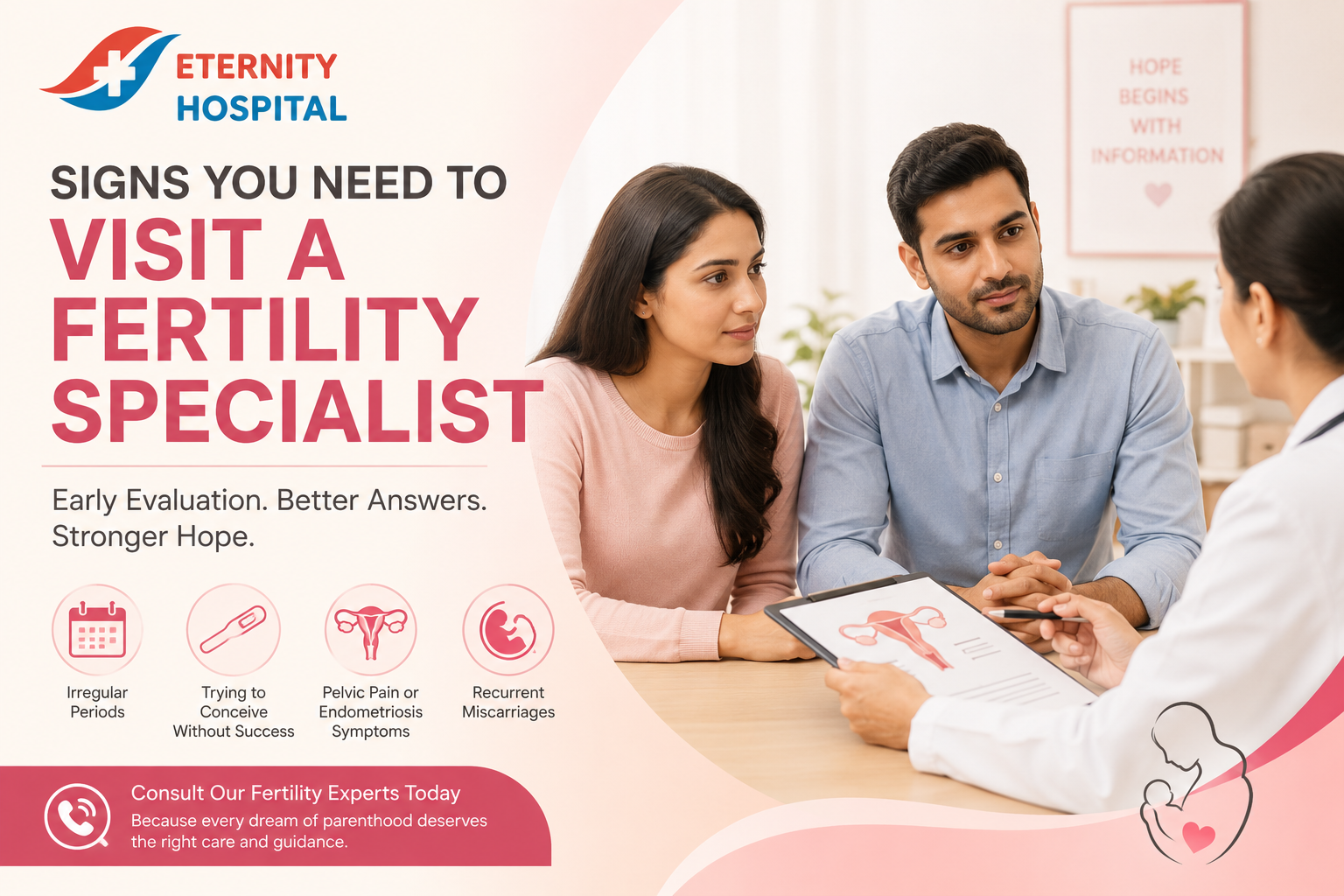
Signs You Need to Visit a Fertility Specialist
Trying to have a baby can be an exciting chapter, but when pregnancy does not happen as expected, the waiting can become stressful and confusing. Many couples wonder whether they should continue trying or whether it is time to speak with a fertility specialist. The important thing to understand is that seeking professional advice does not automatically mean you will need IVF or another advanced fertility treatment. A fertility consultation is often the first step toward understanding what may be affecting conception and what options are available.
According to the American Society for Reproductive Medicine (ASRM), fertility evaluation is generally recommended after 12 months of regular, unprotected intercourse for women younger than 35, while evaluation is generally recommended after 6 months for women aged 35 or older. Women over 40 may benefit from more immediate evaluation.
There are also situations where you should not wait for 6 or 12 months. Irregular or absent periods, suspected endometriosis, known reproductive problems, previous pelvic surgery, possible male-factor infertility, or certain medical treatments can justify an earlier evaluation.
If you are searching for signs you need to visit a fertility specialist, this guide will help you understand when professional evaluation may be appropriate and what you can expect from the process.
Understanding Fertility and Infertility
Fertility is influenced by many interconnected factors rather than one single issue. Ovulation, egg quantity and quality, the fallopian tubes, uterus, sperm production and function, hormones, age, medical history, and timing can all play a role in the ability to achieve pregnancy. Sometimes the cause is relatively straightforward to identify, while in other cases several smaller factors may contribute together. There are also situations in which testing does not identify one clear cause, commonly described as unexplained infertility.
It is also important to remember that infertility is not exclusively a female health issue. Male factors can contribute to difficulty conceiving, which is why professional fertility guidelines recommend evaluating both partners when appropriate. The AUA/ASRM guideline recommends concurrent assessment of both partners, including a reproductive history and semen analysis for the male partner.
When Is It Time to Seek Fertility Help?
The answer depends on your age, medical history, reproductive history, and how long you have been trying. A healthy woman under 35 with regular cycles and no known fertility risk factors may generally try for up to 12 months before an infertility evaluation. However, waiting is not necessarily appropriate when there is already a reason to suspect impaired fertility.
For example, someone with absent periods may not be ovulating regularly, while someone with severe pelvic pain may have symptoms suggestive of endometriosis. A person who has previously undergone pelvic surgery or treatment that could affect reproductive function may also benefit from earlier assessment. The goal is not to create anxiety but to avoid losing valuable time when there is a known or suspected factor that could affect conception.
1. You Have Been Trying to Conceive Without Success
One of the clearest signs that it is time to consider a fertility specialist is simply not becoming pregnant despite regular, unprotected intercourse. For women younger than 35, professional guidance generally recommends an evaluation after 12 months of trying. For women aged 35 or older, the recommended timeframe is generally 6 months.
This timeframe should not be interpreted as a rule that every couple must wait exactly 12 months. Your personal circumstances matter. If you already have a history of irregular ovulation, endometriosis, tubal disease, reproductive surgery, or another condition associated with reduced fertility, evaluation can be appropriate sooner. Similarly, if your partner has a known reproductive health problem, there may be little benefit in delaying assessment.
A fertility consultation can turn uncertainty into information. Instead of repeatedly wondering whether something is wrong, you can discuss your medical history, menstrual pattern, previous pregnancies, medications, lifestyle factors, and your partner’s reproductive health. Appropriate testing can then help identify whether the issue involves ovulation, the reproductive tract, sperm, or another factor.
The 12-Month and 6-Month Guidelines
The commonly used timeframe is straightforward:
Age / Situation When to Consider Evaluation
Woman under 35 After 12 months of trying
Woman 35 or older After 6 months of trying
Woman over 40 Consider more immediate evaluation
Known fertility-related condition Evaluation may be appropriate without waiting.
These recommendations are supported by ASRM and ACOG guidance.
2. You Are Over 35 and Planning Pregnancy
Age is one of the most important factors affecting female fertility. This does not mean pregnancy after 35 is impossible or necessarily problematic. Many women conceive and have healthy pregnancies after 35. However, fertility generally declines with increasing age, making it sensible to be more proactive about evaluation when conception is taking longer than expected.
If you are 35 or older and have been trying for six months without pregnancy, discussing your situation with an appropriate healthcare professional is recommended. If you are over 40, professional guidance suggests discussing fertility evaluation more promptly rather than waiting for a prolonged period.
Age can influence both the number of available eggs and reproductive potential, but an individual’s fertility cannot be accurately determined by age alone. A proper evaluation looks at the complete picture, including menstrual cycles, medical history, reproductive anatomy, and the male partner’s fertility factors. This is why an appointment is more useful than relying on assumptions based solely on age.
3. You Have Irregular or Absent Periods
Your menstrual cycle can provide useful clues about whether ovulation is occurring regularly. If periods are very irregular, extremely infrequent, or absent, it may indicate that ovulation is not happening consistently. Conditions affecting hormones, thyroid function, the hypothalamic-pituitary system, or ovarian function can sometimes contribute to abnormal cycles.
ASRM specifically identifies irregular menstrual cycles, oligomenorrhea, amenorrhea, and certain abnormal bleeding patterns as reasons to begin infertility evaluation without necessarily waiting the standard 6- or 12-month period.
What Irregular Cycles Can Indicate
Irregular periods do not automatically mean infertility. Some people with irregular cycles can become pregnant naturally, while others may need treatment to improve or restore regular ovulation. The important point is that irregular cycles can make conception more difficult to predict and may indicate an underlying condition that deserves attention.
A fertility specialist may review your cycle history and consider appropriate hormone testing or ultrasound depending on your symptoms and medical history. The purpose is to understand why your cycles are irregular, rather than simply treating the menstrual pattern itself.
4. You Have Severe Period Pain or Endometriosis Symptoms
Severe menstrual pain should not simply be dismissed as something every woman has to tolerate. When pelvic pain is severe, persistent, occurs during intercourse, or is associated with other reproductive symptoms, it may warrant medical evaluation. Endometriosis is one condition that can be associated with pelvic pain and infertility.
ASRM notes that pelvic pain, dysmenorrhea, painful intercourse, and other clinical findings can raise suspicion for endometriosis. Endometriosis and pelvic or adnexal adhesions may contribute to infertility in some women.
If you have been diagnosed with endometriosis and want to become pregnant, discussing your reproductive plans with a gynecologist or fertility specialist can be particularly valuable. The best approach depends on factors such as age, symptoms, disease severity, previous treatment, and how long you have been trying.
5. You Have Had Recurrent Miscarriages
Difficulty conceiving is not the only reason someone may benefit from fertility assessment. Recurrent pregnancy loss can also justify an evaluation to understand whether there may be an underlying reproductive, genetic, anatomical, hormonal, or other factor contributing to the losses.
The appropriate investigation depends on the individual’s history and circumstances. Fertility evaluation may sometimes be useful even when a person does not meet the traditional definition of infertility, including situations involving recurrent pregnancy loss or certain genetic considerations.
Experiencing pregnancy loss can be emotionally difficult, so the purpose of evaluation should be to provide a structured medical assessment rather than a judgment. citeturn0search0
Experiencing pregnancy loss can be emotionally difficult, so the purpose of evaluation should be to provide a structured medical assessment rather than encourage self-blame. A specialist can review previous pregnancy records, medical conditions, medications, family history, and other relevant information before recommending investigations.
6. You Have a History of Pelvic Surgery or Infections
Previous surgery involving the pelvis or reproductive organs can sometimes affect reproductive anatomy. Similarly, certain infections can lead to scarring or blockage of the fallopian tubes, interfering with the normal movement of sperm and egg. ACOG identifies tubal scarring or blockage associated with previous infections or endometriosis as one possible contributor to infertility. citeturn0search1
If you have had pelvic surgery, significant pelvic infection, or another condition that could affect the fallopian tubes or uterus, you may not need to wait the standard period before discussing fertility. A medical history can help determine whether earlier assessment makes sense.
Depending on the circumstances, this may include ultrasound or testing of the uterine cavity and fallopian tubes. ASRM identifies hysterosalpingography and saline-based studies among the methods used to evaluate tubal patency. citeturn0search0
7. Your Partner Has Possible Male Fertility Problems
If pregnancy is not happening, it is important not to assume the problem is with the female automatically; it can be affected by male factors involving sperm production, sperm count, movement, or other reproductive issues. ACOG also recognizes sperm-related problems as a potential cause of infertility. citeturn0search7
Previous testicular problems, certain surgeries, reproductive infections, sexual difficulties, or other medical conditions may make a male fertility assessment appropriate. Even when there are no obvious symptoms, semen analysis can provide important information.
Why Both Partners Should Be Evaluated
The AUA/ASRM guideline recommends that both partners undergo assessment concurrently for productive anatomy, hormones, or sperm function. Examples can include disorders affecting the thyroid, conditions associated with abnormal ovulation, known uterine or tubal problems, and endometriosis. citeturn0search0turn0search1
If you already know that you have a condition that could affect conception, it may be useful to discuss fertility before you start trying or early in the process. This is especially relevant when you have previously received treatment that could affect reproductive potential.
A fertility specialist does not necessarily mean you will require advanced reproductive technology. Sometimes the most appropriate step is simply identifying an underlying issue and addressing it. The sooner the cause is understood, the more informed your choices can become.
What Happens During a Fertility Evaluation?
A first fertility consultation is usually about gathering information and understanding the complete reproductive picture. The doctor may ask about your menstrual cycles, previous pregnancies, miscarriages, medical conditions, surgeries, medications, and sexual history, which is an important part of the initial assessment. ASRM recommends evaluating ovulatory status, reproductive anatomy, and tubal patency, alongside semen evaluation of the male partner when applicable. citeturn0search0
Common Tests and Assessments
The exact tests are individualized rather than identical for every patient. Possible assessments may include:
- Menstrual and ovulation history
- Pelvic or transvaginal ultrasound
- Selected hormone testing
- Assessment of ovarian reserve when clinically appropriate
- Hysterosalpingography or another test for tubal patency
- Evaluation of the uterine cavity when indicated
- Semen analysis for the male partner
- Additional tests as per individual situation, and discuss treatment options clearly.
If you are in Ghaziabad, Indirapuram, Siddharth Vihar, Noida, or nearby Delhi NCR areas, you can explore women’s healthcare services at urlEternity Hospitalhttps://www.hospitaleternity.com/ and discuss your fertility concerns with the gynecology team.
How Early Evaluation Can Help
One of the biggest benefits of fertility evaluation is replacing uncertainty with a clearer medical picture. Instead of repeatedly asking whether you should keep waiting, testing can help identify whether there is an issue with reproductive anatomy, sperm, or another factor. ACOG notes that when a cause is found, treatment may be possible, and pregnancy can sometimes be achieved even when no specific cause is identified. citeturn0search1
Early evaluation can be particularly important when age or a known reproductive condition matters. Understanding where you are starting from can help you decide what to do next.
Fertility Care at Eternity Hospital
For couples seeking women’s healthcare in the Delhi NCR region, urlEternity Hospitalhttps://www.hospitaleternity.com/ provides access to gynecology and women’s healthcare services in a hospital-based setting. Fertility concerns can be discussed as part of a broader reproductive health assessment, particularly when menstrual problems, pregnancy planning, PCOS, recurrent pregnancy concerns, or other gynecological issues are involved.
Personalized Fertility and Women’s Healthcare
Every fertility journey is different. One person may need help understanding irregular ovulation, while another may require assessment of the uterus or fallopian tubes. In other cases, evaluating both partners may reveal a male factor that needs attention.
A personalized approach matters because fertility treatment should not be based on a one-size-fits-all checklist. Your age, medical history, reproductive goals, previous treatments, and partner’s health can all influence the appropriate next step. If you are concerned about delayed conception, consulting a qualified gynecology or fertility professional can help you understand your options and make decisions based on medical evidence rather than online assumptions.
Conclusion
Knowing the signs you need to visit a fertility specialist can help you seek appropriate care without unnecessary delay. If you are under 35 and have been trying without success, or if you are 35 or older and have been trying for six months, a fertility evaluation is generally recommended. Women over 40 may benefit from seeking advice sooner. citeturn0search0turn0search1
You should also consider earlier evaluation if you have irregular or absent periods, suspected endometriosis, significant pelvic pain, or previous intercourse without pregnancy. For women aged 35 or older, evaluation is generally recommended after six months. Women over 40 should consider discussing fertility evaluation more promptly. citeturn0search1turn0search6
2. Should I see a fertility specialist if my periods are irregular?
Yes, it can be appropriate to seek help. Eternity Hospital can contribute to difficulty conceiving, and professional guidance recommends evaluating both partners when appropriate. A semen analysis is an important part of the initial male fertility assessment. cite turn0search3