

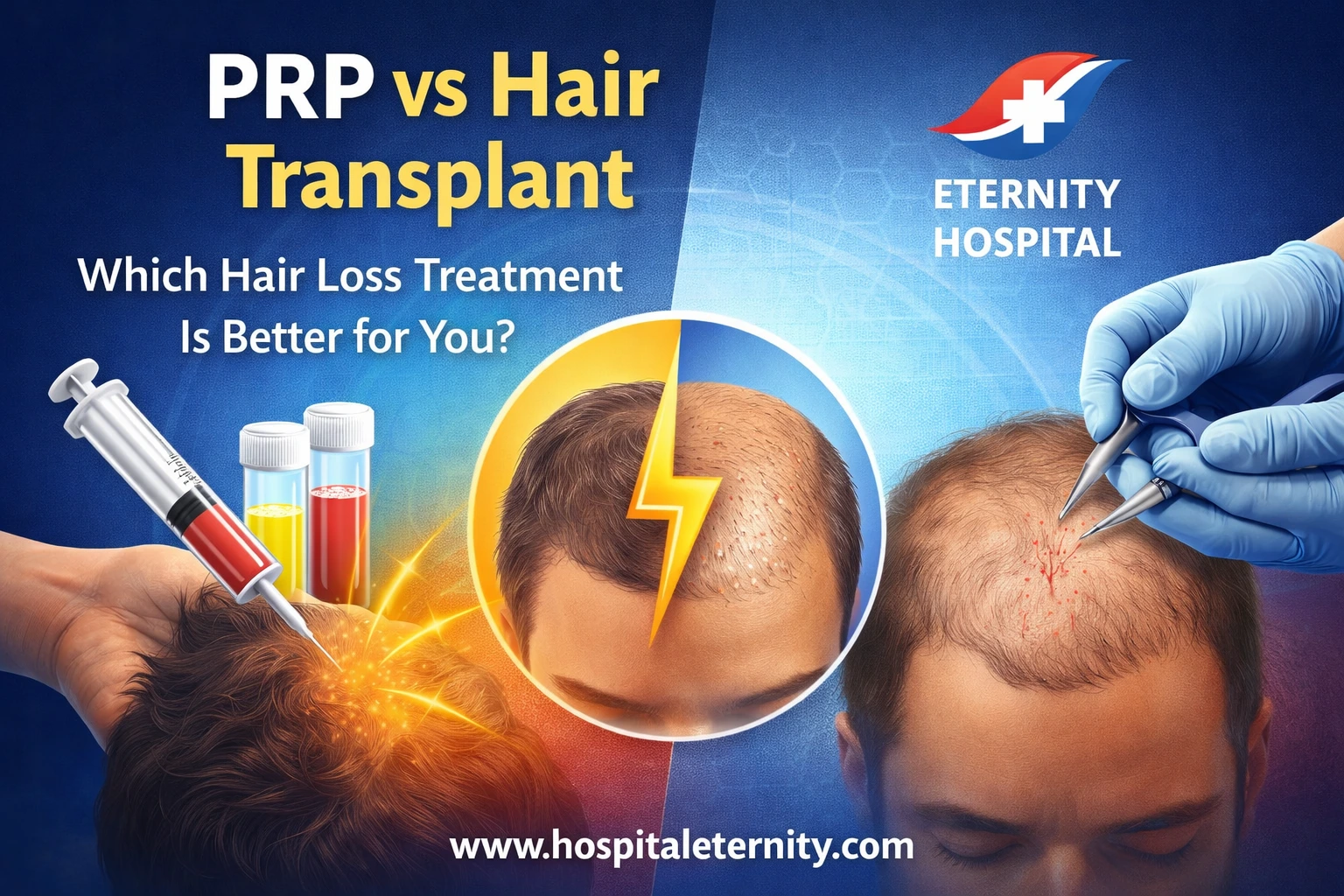
If you are searching for the best treatment for hair loss, you have probably asked yourself one very common question: PRP vs hair transplant — which one is actually better? It is a smart question, and honestly, there is no single answer that fits everyone. Some people only have early hair thinning and can still save a lot of their natural hair. Others already have visible bald patches, a receding hairline, or a crown area that has become difficult to cover. In simple words, PRP and hair transplant are not the same treatment, and comparing them without understanding your stage of hair loss can lead to the wrong decision. That is exactly why this guide exists.
In 2026, more people are choosing evidence-based hair restoration instead of falling for flashy marketing. Recent clinical research published in 2025 found that PRP showed moderate evidence for improving hair density, reducing hair loss, and increasing patient satisfaction, especially when used correctly and in the right candidate group. That same review analysed 43 randomised controlled trials with 1,877 participants, which makes it one of the strongest modern data sets on PRP for alopecia. At the same time, the 2025 ISHRS Practice Census shows that hair restoration surgery remains highly popular worldwide, with member surgeons averaging 178 hair restoration surgeries per year and around 2,347 grafts in a first procedure. That tells us something important: PRP is useful, but hair transplant remains the gold standard for permanent coverage in advanced baldness.
PRP Treatment for Hair Loss in Ghaziabad
If you want a detailed, practical, and honest comparison—not just a shallow “PRP is non-surgical, transplant is surgical” summary—keep reading. This article will break down who should choose PRP, who should choose hair transplant, when both can be combined, what results to expect, what myths to avoid, and why Eternity Hospital is worth considering if you are looking for a hair transplant or PRP treatment in Ghaziabad/Delhi NCR.
Understanding Why This Comparison Matters in 2026
Hair loss today is not just a cosmetic issue. For many people, it affects confidence, social comfort, work presentation, relationships, and even how they feel in their own photos. You look in the mirror, and suddenly the hairline that used to frame your face starts moving back like a slow retreat. Or the crown begins thinning so gradually that you ignore it until bright light exposes everything. This is why PRP vs hair transplant has become one of the most searched hair restoration questions online. People do not just want treatment anymore—they want the right treatment at the right time.
The biggest mistake people make is assuming both options solve the same problem in the same way. They do not. PRP (Platelet-Rich Plasma) is more like a “booster” or “revival therapy” for existing weak follicles. It works best when hair is still present but miniaturised, thin, weak, or shedding. A hair transplant, on the other hand, is a structural solution. It is more like relocating strong, DHT-resistant hair follicles from a donor area (usually the back or sides of the scalp) to areas where hair is already lost or significantly reduced. Think of PRP as watering a struggling plant that still has roots, while a hair transplant is replanting healthy saplings into empty soil. Both have value—but not in the same situation.
What makes 2026 especially interesting is that the conversation is becoming more science-driven. A 2025 systematic review and meta-analysis found that PRP can improve hair density and reduce hair fall. However, it did not show significant improvement in hair thickness across all studies, which is a useful reality check for patients expecting dramatic regrowth in fully bald zones. On the surgery side, global data from the International Society of Hair Restoration Surgery (ISHRS) continues to show strong demand for transplants, especially among younger adults, with the organisation noting that 95% of first-time hair restoration surgery patients in 2024 started between the ages of 20 and 35. That means more people are acting early, which is actually good—because earlier action usually means better planning, better donor management, and more natural long-term outcomes.
What Is PRP for Hair Loss?
PRP for hair loss is a non-surgical treatment that uses your own blood to create a concentrated solution of platelets, which is then injected into the scalp. These platelets contain growth factors that may help stimulate hair follicles, improve blood supply, reduce shedding, and support healthier hair cycling. It sounds almost futuristic, but the concept is actually straightforward: your body already contains repair signals, and PRP tries to deliver more of those signals exactly where hair follicles are weakening. It is one of the reasons PRP became so popular—it feels natural, minimally invasive, and appealing to people who want to avoid surgery.
During a typical session, a small amount of blood is drawn, processed in a centrifuge, and separated so the platelet-rich layer can be extracted. That PRP is then injected into areas of thinning hair. Most patients need multiple sessions, usually spaced several weeks apart, followed by maintenance depending on the severity and cause of hair loss. This is where people often misunderstand the treatment. PRP is not a one-time miracle. It is not a magic switch. It is more like a fitness program for weak follicles—if you stop too soon, expect limited results. If you do it consistently, and if you are the right candidate, it can help preserve and improve existing hair.
Modern evidence supports PRP—but with boundaries. A 2025 meta-analysis of 43 randomised controlled trials involving 1,877 participants found that activated PRP improved hair density, reduced recurrence, and improved patient satisfaction. However, the same analysis also noted that PRP did not significantly improve hair thickness overall, and outcomes varied because PRP protocols are not fully standardised across clinics. This matters a lot because one clinic’s PRP may not be identical to another clinic’s PRP in terms of preparation, platelet concentration, activation method, or injection technique. So when someone says, “PRP didn’t work for my friend,” that does not automatically mean PRP does not work. It may mean the case selection, protocol, or expectation setting was poor.
How PRP Works Inside the Scalp
PRP works by delivering a higher concentration of platelets into the scalp, and platelets release growth factors that may support tissue repair and follicle activity. In hair loss, the goal is not to create brand-new follicles in a bald shiny area. That is a major myth. Instead, the goal is to stimulate weakened follicles that still exist, especially in early androgenetic alopecia or diffuse thinning. This is why PRP can help people who still have hair, but that hair is thinner, weaker, or shedding more than usual. If the follicle is still alive but underperforming, PRP may help it behave better. If the follicle is gone, PRP cannot resurrect it like a superhero movie plot.
Who Gets the Best Results from PRP
The best PRP candidates are usually people with early-stage hair thinning, diffuse shedding, widening partition, mild crown thinning, or recent hair density loss where follicles are still present. Men and women can both benefit, especially if they start before the scalp becomes visibly empty. PRP may also be useful as an adjunct to medical therapy or after surgery. But if you have a completely bald frontal zone, a shiny crown, or long-standing advanced male pattern baldness, PRP alone is usually not the right primary solution. In those cases, asking PRP to do the work of a transplant is like asking paint to fix a cracked wall—it can freshen the surface, but it cannot rebuild the structure.
What Is a Hair Transplant?
A hair transplant is a surgical hair restoration procedure in which healthy hair follicles are taken from a donor area—usually the back and sides of the scalp, where hair is genetically more resistant to balding—and moved to thinning or bald areas. Unlike PRP, which tries to improve what is already there, a hair transplant physically redistributes follicles. That is why it is considered the most direct solution for people with advanced hair loss, receding hairline, deep temple recession, large crown baldness, or visible empty scalp areas.
The key thing to understand is that a hair transplant does not create new hair out of thin air. It is a redistribution strategy, not a multiplication trick. You are moving permanent donor follicles to the front, mid-scalp, crown, beard, or even eyebrows in some cases. If done well, the result can look natural, dense, and long-lasting. If done badly, it can look artificial, pluggy, overharvested, or poorly planned. That is why surgeon skill, donor management, graft angulation, hairline design, and long-term planning matter more than flashy clinic marketing. A cheap transplant can become an expensive regret.
According to the 2025 ISHRS Practice Census, member surgeons reported an average of 178 hair restoration surgeries per year, with 2,347 grafts on average in a first procedure and 1.5 surgical procedures per patient to achieve the desired result. That last number is especially important. Some patients need only one well-planned surgery, while others may need staged restoration depending on donor capacity, progression of hair loss, or desired density. Hair transplant is powerful—but it must be planned like architecture, not impulse shopping.
How FUE Hair Transplant Works
FUE (Follicular Unit Extraction) is one of the most popular modern hair transplant techniques. In FUE, individual follicular units are extracted one by one from the donor area and implanted into the recipient area. It is known for being minimally invasive, leaving tiny dot scars rather than a linear scar, and offering relatively faster healing. This is often the preferred option for people who want shorter hairstyles later, quicker recovery, and a more flexible post-op appearance. At Eternity Hospital, FUE is listed as a core hair transplant service and is described as a modern, minimally invasive option that offers natural-looking hair growth with no visible scars and faster recovery.
How FUT Hair Transplant Works
FUT (Follicular Unit Transplantation), sometimes called the strip method, involves removing a thin strip of scalp from the donor area, dissecting the grafts under magnification, and then implanting them into bald areas. It can be a strong option for certain patients, especially those who need larger graft numbers and have suitable scalp characteristics. It does leave a linear scar, so it may not suit everyone, especially those who prefer very short haircuts. Still, FUT remains valuable when performed by experienced hands and chosen for the right case. At Eternity Hospital, FUT is presented as a good option for larger bald patches and dense, lasting results.
PRP vs Hair Transplant: Core Differences at a Glance
This is the part people really want, but instead of giving you a lazy one-line comparison, let’s break it down properly. PRP and hair transplant differ in goal, mechanism, ideal candidate, permanence, downtime, and expectation level. If you choose the wrong one for your stage of hair loss, you can waste money, time, and emotional energy. That is why a real consultation matters more than social media before-and-after photos.
Here is the clearest way to think about it: PRP is a preservation and stimulation treatment. Hair transplant is a replacement and coverage treatment. PRP tries to improve the health and performance of hair follicles that are still alive but struggling. Hair transplant takes strong follicles from a safe donor zone and moves them into places where your natural hair has already thinned too far or disappeared. If your scalp still has “sleepy soldiers,” PRP may help wake them up. If the battlefield is already empty, you need new soldiers—and that is where transplant comes in.
Another critical difference is permanence. PRP is not usually considered a permanent one-time solution. It often requires a series of sessions and periodic maintenance. Hair transplant, by contrast, moves more resistant follicles that can continue growing long-term in the recipient area. However, the native non-transplanted hair around them can continue to thin if you do not manage ongoing hair loss. That is why many ethical surgeons combine surgery with maintenance strategies like PRP, topical therapies, or medical management. If someone tells you, “one transplant and you will never think about hair loss again,” be careful—that is often oversimplified sales talk.
Surgical vs Non-Surgical
PRP is non-surgical, which makes it attractive for people who are nervous about procedures, want minimal downtime, or are not yet ready for a transplant. Hair transplant is surgical, even when minimally invasive like FUE. That means local anaesthesia, graft extraction, implantation, a healing phase, and a visible recovery timeline. But surgical does not automatically mean “bad,” just as non-surgical does not automatically mean “better.” The right question is not “Which is less scary?” The right question is “Which actually matches my hair loss stage?”
Temporary Improvement vs Permanent Redistribution
PRP can improve hair density, shedding control, and follicle performance—especially in early thinning. But it usually needs maintenance. Hair transplant offers permanent redistribution of follicles from a stronger donor zone to a weaker recipient zone. That makes it the more durable option for visible bald areas, but it still requires smart long-term planning because surrounding native hair can keep miniaturising. This is why many experts view the best hair restoration strategy not as PRP vs transplant, but often PRP + transplant + maintenance, depending on the case.
PRP vs Hair Transplant: Quick Comparison Table
FeaturePRP for Hair LossHair Transplant
Type of treatment: Non-surgical, Surgical
Best for Early thinning, diffuse hair loss, weak follicles, receding hairline, bald patches and advanced hair loss
Can it regrow hair in fully bald areas? Usually, no. Yes, by implanting follicles
Results timeline: Gradual over weeks to months. Visible growth starts after months, full results often 8–12 months.
Permanence usually requires maintenance. Transplanted follicles are long-lasting/permanent.
Downtime: Minimal. Mild to moderate recovery period
Main purpose: Strengthen existing hair, restore hair where hair is already lost.
Ideal use with other treatments Yes Yes
Which Treatment Gives Better Results?
The honest answer is simple: the better treatment depends on what you are trying to fix. If you are in the early stages of hair loss, PRP may be the smarter first step. If you already have clearly visible baldness or a receding hairline that has crossed the point of no return, a hair transplant usually gives more meaningful cosmetic improvement. This is where so many patients get frustrated—they choose a treatment based on fear or budget, not based on hair loss pattern. Then they say, “It didn’t work.” But the truth is often that the treatment was mismatched to the problem.
PRP tends to “win” when the follicles are still alive. That means thinning hair, weak density, recent shedding, mild crown loss, or early pattern baldness. It can help improve density and reduce falls, especially when used consistently and combined with a broader plan. Research from 2025 supports that PRP can improve hair density and reduce hair loss, but it does not reliably transform a slick bald scalp into a full hairline. So if your expectation is “I am bald in the front, and PRP will fill it,” you are setting yourself up for disappointment. PRP is a supportive tool, not a miracle transplant substitute.
Hair transplant “wins” when the issue is missing hair, not just weak hair. If your frontal hairline has significantly receded, temples are empty, or the crown has obvious baldness, surgery usually provides the most visible and satisfying transformation. The transplanted follicles physically occupy space that was previously empty. That is why the visual change is often dramatic when planned correctly. But remember, the best surgeons do not chase density unthinkingly—they design for naturalness, age-appropriate hairline placement, and future hair loss progression. A transplant that looks dense at 28 but strange at 35 is not good.
When PRP Wins
PRP is often the better first option if:
- You have early hair thinning
- You still have visible miniaturised hair
- You want to slow progression
- You are not ready for surgery yet
- You want to support existing hair before considering a transplant
- You need a maintenance or adjunctive therapy
When Hair Transplant Wins
Hair transplant is usually the better option if:
- You have bald patches
- Your hairline has receded significantly
- Your crown is visibly empty
- You want more permanent coverage
- You have a good donor area
- You understand that native hair may still need maintenance
PRP vs Hair Transplant Cost, Recovery, and Downtime
People often begin by asking, “Which one is cheaper?” That is understandable, but it can be a trap. The cheaper option is not always the more cost-effective one. If you need a transplant but spend months or years on PRP expecting it to rebuild a bald hairline, you may spend less per session but more overall with weaker results. On the flip side, if you have early thinning and jump straight into surgery without stabilising ongoing loss, you may use up donor hair too early or create an unnatural long-term pattern. Smart spending starts with smart diagnosis.
PRP is usually lower cost per session, but it is often a multi-session and maintenance-based treatment. Publicly available health content notes PRP pricing can vary widely by region and setup, and estimates for PRP in general medicine are often cited in the $500–$2,500 per session range. However, hair-specific pricing varies significantly and is usually location-dependent. In India, pricing can differ a lot by city, clinic quality, PRP protocol, and doctor involvement. Hair transplant usually has a higher upfront cost because it is a surgical procedure, often based on graft count, technique (FUE vs FUT), doctor’s expertise, and clinic standards. At Eternity Hospital, the site states that hair transplant cost depends on factors such as the number of grafts required and the technique used, while also emphasising affordable and transparent pricing.
Recovery is another major difference. PRP usually has minimal downtime. Some patients experience mild tenderness, redness, swelling, or scalp sensitivity, but most return to normal activity quickly. Hair transplant has a longer visible recovery curve. There can be scabbing, redness, donor discomfort, and a shedding phase before new growth begins. Many patients panic during post-transplant shedding, but that is often part of the normal cycle. New hair typically starts appearing in a few months, while more complete cosmetic results often take 8–12 months. Eternity Hospital specifically notes that new hair can start growing around 3–4 months, with fuller results around 8–12 months.
Cost Expectations
A practical way to think about cost:
- PRP = lower entry cost, recurring commitment
- Hair transplant = higher upfront cost, longer-term structural result
The better value depends on whether you are trying to save hair or replace lost hair.
Recovery Timeline
A simple reality:
- PRP = quick return, mild downtime
- Hair transplant = healing + shedding + regrowth timeline, but more visible transformation potential in the right candidate
Can PRP and Hair Transplant Be Combined?
Yes—and this is where many people finally understand the bigger picture. In real-world hair restoration, the smartest question is often not “PRP or hair transplant?” but “How should PRP and hair transplant be used together?” Hair loss is not always a single-event problem. It is usually progressive. You may have one area that is already too far gone and another area that is only beginning to thin. That means one part of your scalp may need surgery, while another part may benefit from preservation therapy. This is why combination plans often make the most sense.
There is also growing research interest in using PRP as an adjunct to transplantation. A 2025 systematic review focused specifically on PRP as an adjunct to hair transplantation, evaluating whether it could improve outcomes such as graft survival, hair density, hair thickness, and patient satisfaction compared with transplant alone. While protocols vary and not every study is identical, this direction is clinically important because it reflects how modern hair restoration is evolving: not as a one-tool solution, but as a layered strategy.
Think of it like building a house. The transplant lays the foundation and structure where there is space. PRP can help improve the quality of the surrounding environment—supporting existing hair, possibly helping with healing, and sometimes being used in broader maintenance plans. When done properly, this can lead to a result that not only looks fuller but also ages better over time.
PRP Before Hair Transplant
PRP before a transplant may be considered when:
- You still have a lot of miniaturised native hair around the transplant zone.
- The doctor wants to improve the health of the surrounding hair.
- The goal is to stabilise shedding or enhance scalp condition before surgery.
- You are trying to decide whether some areas can be improved without graft use.
PRP After Hair Transplant
PRP after a transplant may be used in some clinics as a supportive option to:
- Help with scalp recovery.
- Support surrounding native hair
- It could aid the graft environment.
- Build a longer-term maintenance plan.
Not every patient needs PRP after transplant, and not every clinic uses the same protocol. The right decision depends on donor quality, scalp condition, native hair status, and the surgeon’s approach.
Why Eternity Hospital Is a Strong Choice for Hair Restoration
If you are looking for a hair transplant in Ghaziabad, a hair transplant near Delhi NCR, or a clinic that offers both hair transplant and PRP, Eternity Hospital stands out because it clearly offers a broader hair restoration approach instead of forcing one single solution for everyone. On its hair transplant services page, the hospital lists FUE hair transplant, FUT hair transplant, beard and moustache hair transplant, eyebrow hair transplant, PRP (Platelet-Rich Plasma) therapy for hair regrowth, and hairline correction. That range matters because it suggests the clinic is positioned to assess the patient’s actual need rather than simply pushing a single package.
Another strong point is access and convenience. Eternity Hospital lists its address as Plot No 914, Niti Khand 1st (Opp. Orange County), Indirapuram, Ghaziabad 201014, with contact numbers including 0120-4558400, 0120-4558401, +91 9873112993, and +91 9971161916. The website also states Monday to Sunday – 24 Hours, which can be reassuring for patients who want flexibility, especially those travelling from nearby areas in Ghaziabad, Noida, East Delhi, or wider NCR. The site also provides a contact email: care@hospitaleternity.com.
From a branding and service perspective, this is useful for SEO and user trust too: the hospital specifically markets itself for advanced hair transplant services in Ghaziabad, promising safe, painless, highly effective procedures, personalised hair restoration solutions, and natural-looking results. Whether you are exploring PRP for early hair thinning, FUE for receding hairline, FUT for larger bald areas, or hairline correction, the presence of multiple treatment categories under one roof is a positive sign. For users who want to check services directly, you can visit Hospital Eternity Hair Transplant Services or reach the hospital via the Hospital Eternity Contact Page.
Hair Transplant Services Available at Eternity Hospital
According to the hospital website, the available hair restoration services include:
- FUE (Follicular Unit Extraction) Hair Transplant
- FUT (Follicular Unit Transplantation) Hair Transplant
- Beard and Moustache Hair Transplant
- Eyebrow Hair Transplant
- PRP Therapy for Hair Regrowth
- Hairline Correction
This is especially useful for patients who want both non-surgical and surgical options in one consultation.
How to Book a Consultation with Eternity Hospital
You can contact Eternity Hospital through:
- Address: Plot No 914, Niti Khand 1st (Opp. Orange County), Indirapuram, Ghaziabad 201014
- Phone: 0120-4558400 / 0120-4558401 / +91 9873112993 / +91 9971161916
- Email: care@hospitaleternity.com
For direct website actions:
How to Decide: PRP or Hair Transplant? A Practical Decision Framework
If you want the most practical answer possible, use this mental checklist before spending money. First, ask: Do I still have hair in the area, or is the area mostly empty? If you still have thinning hair, miniaturised strands, a widening partition, or a softer crown but not a completely bald surface, PRP may be worth exploring first. Second, ask: Am I looking for improvement, or am I looking for real coverage? PRP often improves quality, density, and shedding control. Hair transplant creates coverage where there is loss. Third, ask: What is my long-term plan? Hair loss is progressive. A good treatment plan is not just about today’s selfie—it is about how your hair will look 3–10 years from now.
If you are under 30 and your hair loss is still evolving, this becomes even more important. Many younger patients rush toward a low, aggressive hairline transplant without stabilising ongoing loss. That can look good in the short term, but strange later if the surrounding native hair keeps disappearing. On the other side, some patients spend too long doing PRP on areas that already need grafts. That delays the inevitable and sometimes creates frustration with all treatments, even though the problem was timing, not the treatment itself.
The best route is almost always:
- Accurate diagnosis
- Scalp and donor evaluation
- Stage of hair loss assessment
- Expectation discussion
- Personalised plan (PRP, transplant, or combination)
That is why clinics that offer both, like Eternity Hospital, can be useful—they can assess whether you need preservation, restoration, or both.
Conclusion
So, PRP vs hair transplant — which is better? If you want the most honest answer, here it is: PRP is better for saving weak hair; hair transplant is better for replacing lost hair. PRP can be a very good option for early thinning, diffuse loss, and maintenance, especially when follicles are still alive and need support. A hair transplant is the stronger option when you already have visible baldness, a receding hairline, empty temples, or a thinning crown that no longer responds well to conservative measures. Neither treatment is “best” in isolation. The best treatment is the one that matches your stage of hair loss, donor quality, expectations, and long-term plan.
Modern evidence supports PRP as a useful tool, but not a magical substitute for surgery in advanced baldness. At the same time, hair transplant remains the gold standard for permanent-looking restoration in the right candidate, especially when performed with proper planning and realistic expectations. And in many real-world cases, the smartest answer is not PRP vs transplant, but PRP + transplant + maintenance.
If you are in Ghaziabad, Noida, or Delhi NCR and want a consultation for hair thinning, PRP therapy, FUE hair transplant, FUT hair transplant, beard transplant, eyebrow transplant, or hairline correction, Eternity Hospital is a solid clinic to consider because it offers both surgical and non-surgical hair restoration options in one place. For many patients, that is exactly what matters most: not hype, not shortcuts—just the right treatment for the right scalp.